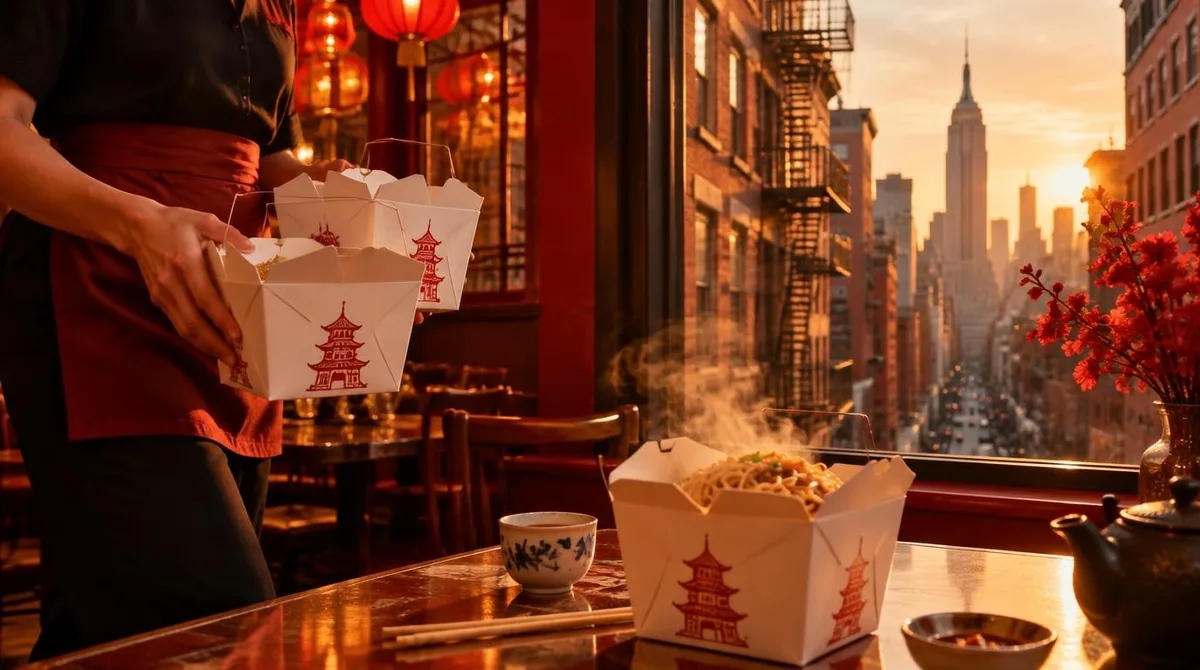
The Chinese takeout box started life as an oyster pail, folded from paper in the 1890s and never really redesigned since. Its paperboard walls and wire handle now carry lo mein out of American Chinese kitchens in every borough, and the design has outlived the oyster trade that built it.
The story runs through New York kitchens as much as any. American Chinese restaurants made the cheap folded pail their standard issue, and the format changed how the city eats: restaurant food packed for the train home, eaten straight from the box. Here is how a container for raw oysters became the default packaging for dinner at home. For related coverage, see Boiled, baked, union-made: the New York bagel's century from Yiddish delis to every corner in town.
Where did the folded paper box come from?
The paper pail has a paper trail. The record for patent 529053, published November 13, 1894, describes an improvement on an 1890 paper pail patented to Wilcox and Moshier. The stated goal: a pail folded from a single piece of paper, with inner walls plain and unbroken by folds, creases or projections, so nothing catches or withholds the contents. The bail, the wire handle, seats into pockets scored into the sides.
That folding logic is the whole trick. One flat sheet, a few creases, and the box stands, closes, and vents steam through its own geometry. No glue, no hinges, no parts to lose. We covered a connected angle in One neighborhood, many kitchens: how Manhattan's Chinatown ate its way through five waves of immigration.
Why did oyster pails end up at Chinese kitchens?
Per packaging firm Lekac, F.W. Wilcox chose paper over wood for food packaging because wood absorbs moisture and resists disinfecting, while waxed paper keeps liquids in and can even unfold flat into a serving plate. The pail was built for raw oysters carried home from the counter, and it did that job well enough to outlast it.
American Chinese kitchens turned it into takeout infrastructure: cheap enough to give away with an order, sturdy enough for fried rice, and tight enough for sauced dishes when kept upright. Lekac adds a wrinkle worth knowing: the dishes the box carries are tuned to American tastes, and the pail itself is rarely seen in China.
What did the red pagoda print change?
In the 1970s, per Lekac, a graphic designer at Fold-Pak updated the plain white box with a red pagoda and the words thank you, set in a face styled to look like Chinese calligraphy. The print tied the container to Chinese cuisine so firmly that the shape alone now signals what is inside, pagoda or not.
The shorthand runs in both directions. A stack of white boxes on a pass says American Chinese before the labels go on, and the association has held for half a century of orders.
What does the box do for dinner at home?
The modern version is still the old one, with better liners. Fold-Pak, the brand carried by Smurfit Westrock, describes the original and popular Chinese takeout box as solid bleached sulfate paperboard with an interior poly coating that resists moisture and grease, sold in a range of sizes with stock designs or custom print.
For the household, the box quietly rewrote the meal. Dinner no longer required a table reservation or a dish rotation: the container is the plate, the leftovers storage, and the advertisement on the shelf, all at once. In New York it rides the subway home from Chinatown counters and avenue pickup windows, and it comes back the next night for the same shift.
Conclusion: a design that refuses to retire
Chinese takeout boxes survived because the original brief never changed: one sheet of paper, folded to carry hot food a long way, at a price a corner kitchen can absorb. The patent drawing from 1894 would still read as a spec sheet today. Few food tools can say the same.
The next update will come from materials, not geometry, as operators trade poly liners for newer coatings and plastic alternatives. The pagoda will stay. The handle will stay. The wire, the folds, and the shape will keep doing exactly what Wilcox and Moshier asked of them in 1890.