A kosher certification agency does not post a menu price. A deli that wants the stamp gets a custom quote, usually a flat annual fee that covers rabbinic oversight and year-round inspections, per certifier OK Kosher. The bigger line item is often the mashgiach, the on-site supervisor whose wage runs on top of it.
The math matters on Lexington Avenue as much as anywhere. Kosher delis anchor blocks of the Upper East Side, and the certification behind the word carries three costs at once: the agency fee, the supervisor on payroll, and a kitchen run to a different set of rules. Here is what the paperwork actually asks of a New York deli. Readers following this should also see How the New York deli sandwich got its architecture: a short history in three counters.
What does a certifier charge a deli?
OK Kosher, whose symbol sits on more than 600,000 products by its own count, publishes the shape of the deal on its certification page. The fee arrives as a quote, and per the agency it is flat: it does not scale with the number of products a facility makes or the size of its output. It scales with the scope of the certification program, and location plays into the cost of inspections. The quote usually covers the whole package, including the year-round visits.
There is no public rate card, and the agency does not print dollar figures. What a deli buys is staff time: a Rabbinic Coordinator who designs the kosher program and visits once a year, plus a field representative who drops in throughout the year to check that the program is being carried out. This connects to our earlier piece, East Harlem’s chopped cheese, and the two men who say they invented it.
What changes inside the kitchen?
Before any symbol goes up, the ingredients go under review. Per OK Kosher, a new applicant submits raw materials for screening, then books a site walkthrough where the coordinator sets up the kosher procedure for the line. The process usually runs several weeks from application to certified, per the agency.
On the floor, the rules of kashrut shape the room: meat and dairy stay separate, and the menu gives up whatever conflicts. For a pastrami counter that is an easy trade. For a diner with a mixed menu, it is a rewrite of the walk-in, the fryers, and the prep list.
The door swings both ways. A new product or process goes back through the certifier before it reaches the menu, and a change can shift the visit schedule or the fee, per OK Kosher. The supervision follows the kitchen, not the other way around.
Who is the mashgiach on the payroll?
The supervisor is a job, and jobs have wages. Talent.com, a salary aggregator, puts the average mashgiach pay at $57,200 a year in the United States, about $28.95 an hour, based on 12 reported salaries as of 2026. Entry listings start near $41,535, and the top of the range reaches $93,600.
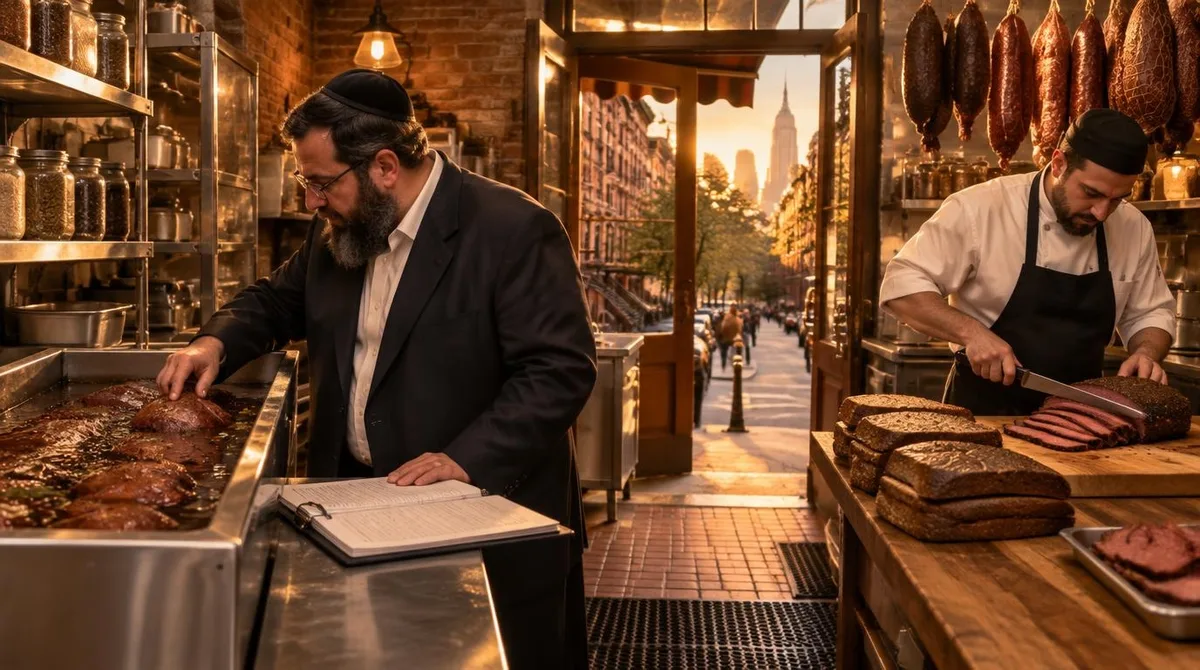
At a deli counter the role is hands-on. The mashgiach checks incoming deliveries, watches prep and service against the certified program, and confirms the kitchen follows the rules the certifier signed off. That salary lands on top of the agency fee, and it recurs every week the kitchen runs.
Conclusion: the stamp is payroll, not paperwork
A deli shopping for kosher certification is pricing two salaries and a schedule: the certifier’s annual fee, the mashgiach’s weekly check, and the visits that keep both honest. On the Upper East Side, Pastrami Queen holds the certified-kosher flag at its UES and UWS locations, per the operator, with the original counter at Lexington Avenue and East 78th Street running from 10 AM to 9 PM as of October 2026.
For operators, those costs buy a customer base that will not walk in without them. For the cooks and supervisors on the payroll, they buy steady, skilled work in a city that eats pastrami all year. The fee quote stays private. The line at the counter does not.