Midtown lunch counters made it through the office exodus by shrinking to the weekday grid. Office attendance in Manhattan stood at 57 percent of workers on an average weekday in March 2025, which works out to 76 percent of pre-pandemic levels, per a Partnership for New York City survey of more than 125 major employers. The counter format, built for a noon rush, cut its hours to match.
The exodus was never a clean break, and the recovery is not one either. Hybrid schedules spread the crowd across a few busy days, and the counters on the blocks around Grand Central Terminal and up Sixth Avenue plan their staff around them. Here is what the attendance data, the tax math, and one landmark counter on 42nd Street show about who made it. We covered a connected angle in The bodega and the halal cart: how Manhattan's street food economy actually works.
What the office numbers show
The Partnership for New York City surveyed more than 125 major Manhattan office employers between March 5 and March 20, 2025. Its count: 57 percent of Manhattan office workers are at their desks on an average weekday, equal to 76 percent of pre-pandemic attendance. Most employers run a hybrid policy; 69 percent do, per the same survey. The weekday spread looks like this:
- 10 percent of Manhattan office workers go in five days a week.
- 26 percent go in four days, and 30 percent go in three.
- 16 percent go in two days, and 9 percent go in one.
- 8 percent are fully remote.
Those swings land straight on the line. A room that once sold a hundred sandwiches a day now plans its bread order around a crowd that arrives in waves, heaviest where employers pushed attendance requirements back up.
What the missing workdays cost
The fiscal math came from the comptroller. A 2021 analysis, archived from the Stringer administration, priced a two-day-a-week remote schedule: the city could lose $111 million in sales tax revenue a year as office spending shifted or stopped. Commuters cutting office days could pull over $1.6 billion in taxable spending out of the city. The report names the line items plainly: lunch, coffee, shopping, drinks after work.
For a counter on East 42nd Street, that is not an abstraction. It is rent, bread, and a shorter line at 1 PM, and it explains why so many rooms added catering runs and delivery windows instead of betting everything on the walk-in trade.
Who still queues at noon on 42nd Street
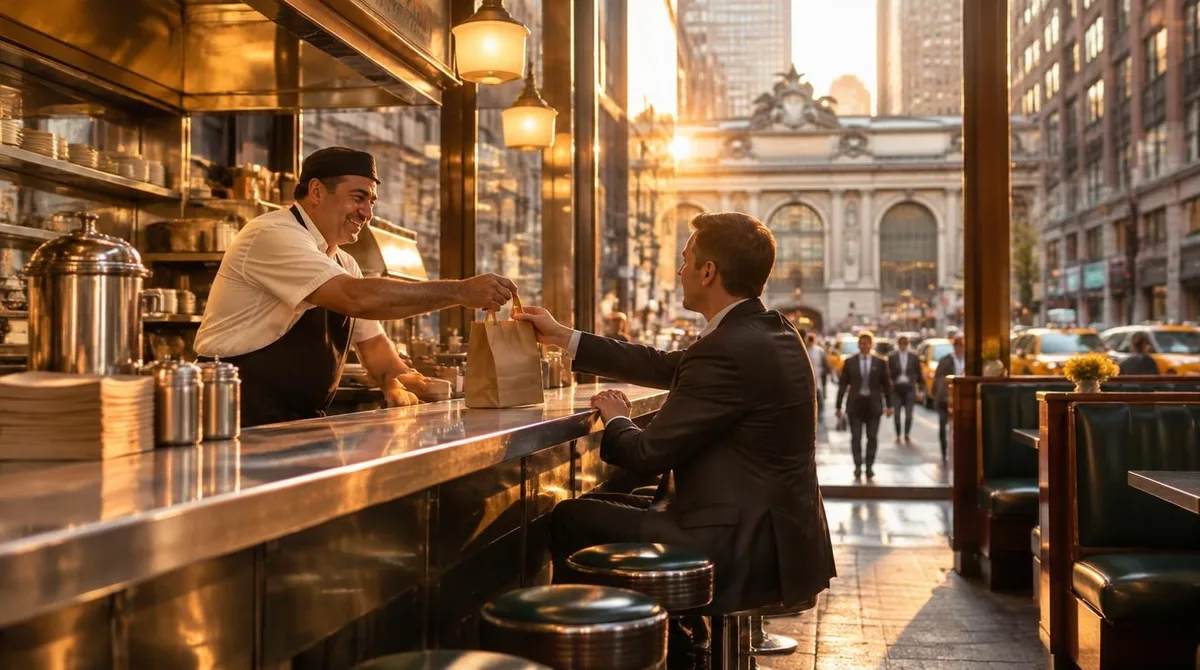
The Grand Central Oyster Bar sits on the lower level of the terminal at 89 East 42nd Street, under the Guastavino vaults, and its posted schedule reads like a diagnosis of the lunch economy. Per the operator, the room opens Monday through Friday at 11:30 AM, takes a last seating at 9:30 PM, and closes the kitchen at 10 PM. No weekend service is listed, as of October 2026.
That cadence is the surviving format. The counter runs on commuters and office staff, works the noon rush hard, and lets Saturday and Sunday go. The restaurant's own history notes a take-out window on the ramp between the terminal's levels, set up for exactly that trade.
Conclusion: the counter as weekday instrument
Lunch counters survived the office exodus the way a diner survives a highway reroute: they matched the traffic they actually get. The office crowd is back to roughly three-quarters of its old size, but it arrives in waves, and the counters that made it plan around those waves rather than against them. Weekday hours. Counter service. A take-out window near the trains. For related coverage, see One neighborhood, many kitchens: how Manhattan's Chinatown ate its way through five waves of immigration.
The lease math favors the same shape. A small room with a counter carries a smaller rent check than a full dining room, and it can flex staff to the busy days on the schedule. Nothing about that trade is glamorous. It is the noon rush, five days a week, and right now it is enough.