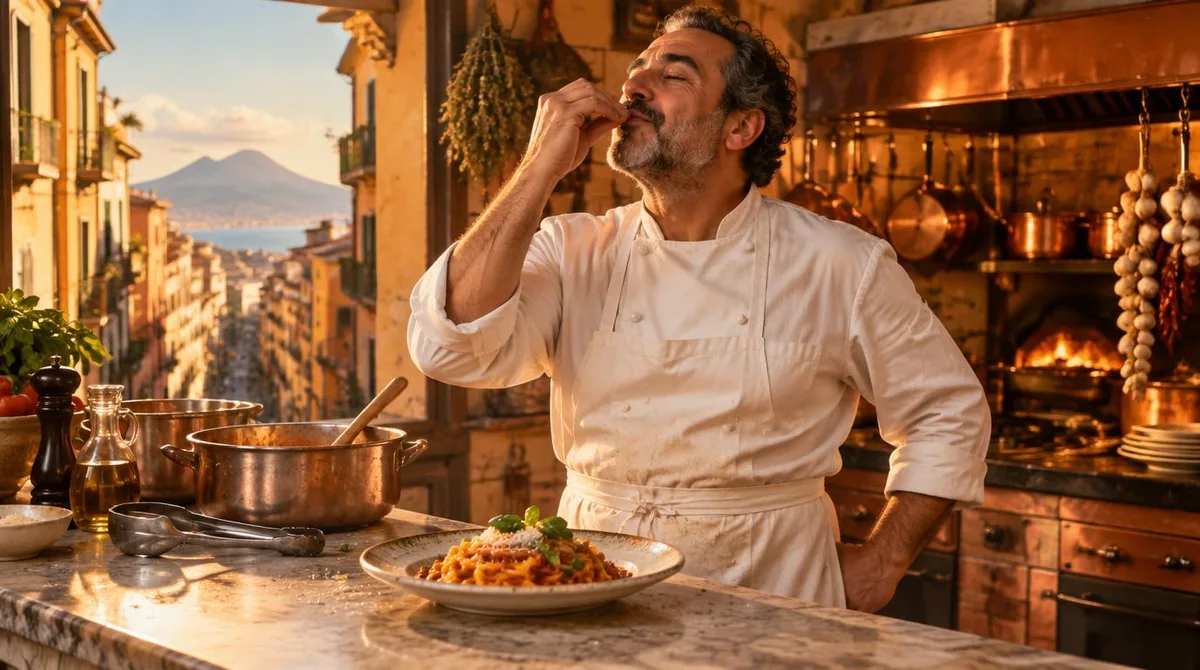
The chef's kiss is simple to do and hard to fake. A cook presses thumb and fingers together, kisses them, and pulls the hand apart. The gesture means one thing: this is perfect, and I don't need words to say so.
It didn't start in New York, and it didn't start online. The gesture is widely traced to Italy, where it grew out of everyday hand talk long before it became kitchen slang. Italian speakers use their hands the way other people use punctuation, and the kiss-and-open motion fit a cook's needs exactly. It praises without stopping work. It lands across a loud room. And it flatters the food, not the cook. Readers following this should also see Why New York chefs cook staff meal first: the kitchen's own dinner, explained.
So why did this one gesture outlive a thousand other bits of kitchen shorthand? Part of the answer sits in the word itself. According to US Dictionary, "why" works as a question, a reason, and an interjection that adds emphasis — and the chef's kiss answers all three at once. It asks why the dish works, gives the reason, and underlines the point in a single motion.
Where the gesture comes from
The gesture's Italian roots are the part most language watchers agree on. In Italy, the motion is often called the bacio del cuoco — the cook's kiss — and it belongs to a much larger family of hand gestures that carry meaning on their own. A pinched, raised hand can mean a question or an exasperated plea. The kiss-and-release means approval pushed to the limit.
What made it a kitchen gesture is practical. Kitchens are loud. The pass is crowded. A cook tasting a sauce can't step back and deliver a speech. A hand signal travels over the noise, takes less than a second, and reads from across the line. The gesture also has a built-in humility. The kisser touches his own fingers, not the plate. The praise points at the food.
From Italian kitchens, the gesture moved with the cooks. Italian immigrants carried it into restaurant kitchens across Europe and the Americas, where it sat alongside other trade shorthand — the pointed finger at the pass, the twirl that means more plates coming. Kitchen crews are mixed crews, and gestures cross language lines faster than words do. A dishwasher from Puebla and a sous chef from Naples don't need a shared vocabulary to share a signal.
How it became kitchen slang
Inside the brigade, the gesture does real work. When a cook on the line tastes a sauce and gives the sign, that's a go signal — the dish can run. When an expediter gives it back, that's confirmation. The motion sits inside a chain of command that runs from prep to the pass, the same structure that decides who calls the shots on a busy night.
It also marks the moment a dish leaves the kitchen. The last look before the plate goes out is the cook's last chance to judge it. The chef's kiss is the verdict, delivered in silence. That's why it carries more weight than the word "perfect" said out loud. Anyone can say the word. The gesture means the cook tasted it, checked it, and signed off.
The slang then leaked out of the kitchen the way kitchen slang always does. Servers picked it up from cooks. Diners picked it up from servers. Somewhere along the way it stopped being a trade signal and became a general-purpose sign of delight — the same path other kitchen words took into everyday speech.
When pop culture picked it up
The gesture's leap from kitchen to mainstream ran through movies, television, and comedy. Performers used it as a quick, visual punchline for anything done with flair — a meal, a performance, a well-timed exit. Because the motion is exaggerated and easy to read at a glance, it survived the jump to the screen better than quieter trade gestures did.
That screen life is what set up the internet era. By the time social media arrived, a broad audience already knew what the gesture meant. It needed no caption. That made it perfect meme material: a reaction image of approval that works in any language and needs no translation.
The emoji sealed it. The chef's kiss now lives on every phone keyboard as a standard symbol, usually drawn as a face with a hand at the lips. The emoji did something the gesture alone never could: it made the sign available to people who had never stood on a restaurant line. A gesture born as working shorthand became a universal button for "excellent."
What the gesture means inside a professional kitchen today
Walk any New York kitchen during service and the old signals still run. The chef's kiss hasn't been replaced by the emoji; the two live side by side. In the room, the physical gesture still carries the professional weight. On the group chat, the emoji carries the joke. This connects to our earlier piece, What a chef stage taught them: how New York cooks use short stints to change direction.
There's a reason the gesture stuck in kitchens specifically. Cooking is a craft judged in instants — a sauce at the right moment, a crust at the right color. The chef's kiss is a verdict that fits in an instant. It also travels well between stations. A pastry cook finishing a plate and a savory cook watching from the pass can share the sign without breaking rhythm, the same way the brigade divides the work station by station.
Our analysis: the gesture survived because it does three jobs at once. It signals approval, it signals that the signer actually tasted or saw the thing, and it does both without stopping the line. Very few pieces of kitchen slang can claim that résumé. Most trade shorthand dies when the trade changes. This one adapted — from the line, to the dining room, to the screen — without losing its meaning.
How to use it — and when not to
Practical steps, for readers who want to deploy the gesture without embarrassment. First, earn it. The sign means the thing was genuinely excellent, so save it for the dish that deserved it. Second, make the motion cleanly: fingers and thumb pinched, a real kiss or a near-kiss, then the hand opens as it pulls away. The flourish is the point. Half the gesture reads as sarcasm.
Third, read the room. In a professional kitchen, the sign is a working signal, so it lands best from someone in the trade or at the counter. From a diner at a table, it works as a warm compliment to the room — but the words "chef's kiss" said aloud can read as a cliché faster than the gesture itself. The motion has outlived the phrase.
The gesture's history is a small lesson in how language actually moves. It started as a practical signal among Italian cooks, became trade slang, got picked up by pop culture, and ended as a keyboard symbol used by people who have never worked a Friday service. The meaning never changed. Only the room got bigger.