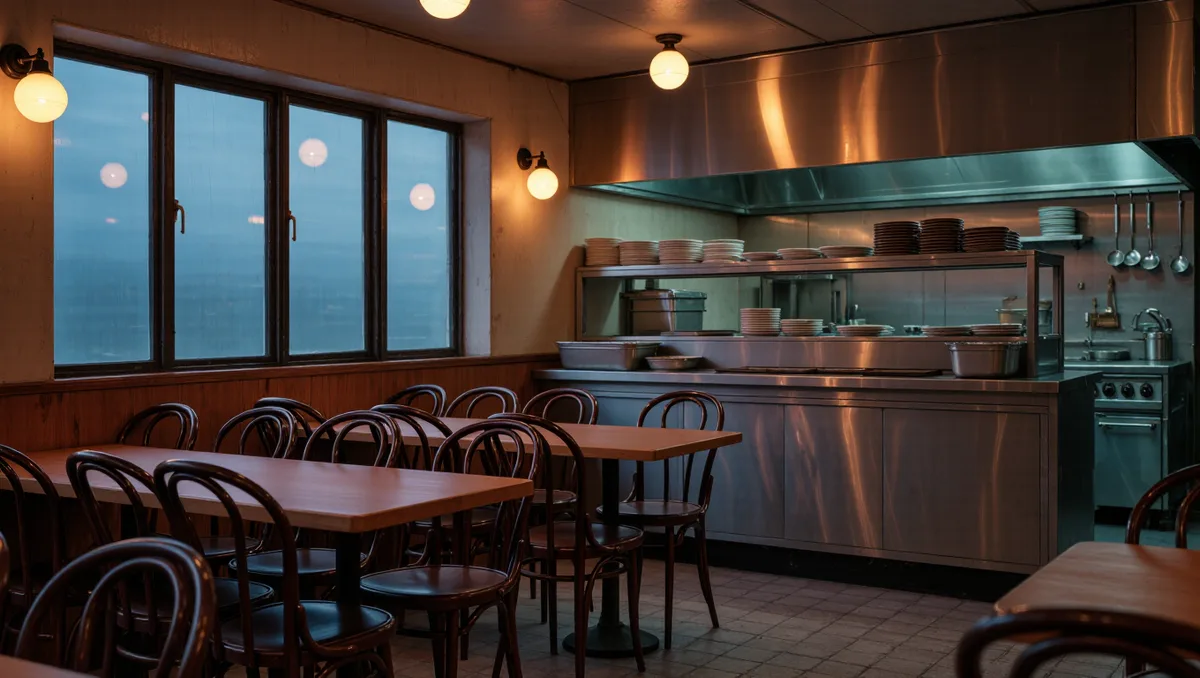
A line cook at a Midtown hotel wants to move into pastry. A sous-chef at a bistro wants to open her own room and needs to see how a bigger kitchen buys, staffs, and runs a service. Neither needs another job. Both need a stage.
In kitchens, a stage is a short working stint — often a shift, sometimes a few weeks — where a cook works alongside a team to learn how that kitchen operates. The word comes from the French, and it traces back to the theater: Cambridge Dictionary lists "stage" as both a theater noun and a verb meaning to put on a production, and kitchens borrowed the sense of stepping onto a stage to perform. In New York, the stage has a well-known day job as a tryout shift for hiring, which we've covered before. This piece is about its second use: the stage as a deliberate career tool, taken by cooks who already have work and want to change direction.
Why would an employed cook work for free?
The honest answer is access. A kitchen's real knowledge — how the chef writes a menu, how the sous-chef orders for a 200-cover night, how the team handles a Saturday push — doesn't show up in a job listing or a cookbook. It only shows up on the line. A stage buys a few hours or weeks inside that system.
For a cook changing direction, the calculus is specific. Moving from savory to pastry, from a small room to a large one, or from a hotel banquet operation to an open kitchen means learning a new set of habits. A stage lets a cook test the new track before committing to it. It's the same logic as sitting in on a class before enrolling: cheap to sample, expensive to guess wrong.
There's a limit to flag here, and it's a real one. A short stage is a sample, not a credential. Nobody becomes a pastry chef in two weeks of plating desserts. What a stage can do is show a cook whether the new direction fits — whether the pace, the precision, and the temperament match — before they invest months or years in it.
What a stage actually teaches
The learning falls into a few buckets, and they're worth naming because they're not equal.
- Technique. The most obvious gain, and often the smallest. A cook can pick up a knife cut, a sauce method, or a lamination process in a shift. But technique transfers fast for anyone with line experience — it's the rest that's scarce.
- Systems. How a kitchen orders, preps, schedules, and cleans. This is the knowledge that separates a good line cook from a future sous-chef, and it's nearly invisible from the outside. A stage at a larger operation shows a cook how a much bigger machine runs.
- Culture and pace. Every kitchen has a temperament. Some are loud and competitive; some are quiet and exacting. A stage is the only honest way to feel that temperament before accepting a job in it.
- Relationships. The cook you stage with remembers you. Kitchens in New York are small worlds, and a good stage — even an unpaid one — is a referral that travels.
Our analysis: for a cook changing direction, the systems and the culture matter most. Technique follows anyway once you're on the payroll. What a stage uniquely offers is a preview of the whole operation, not just the food.
The three stages a career-stage cook runs
Because the hiring-stage version of this shift is already well documented — see our guide to how New York kitchens run the tryout shift that decides who gets hired — it helps to separate the career-stage into a few distinct shapes. For related coverage, see The stage, explained: how New York kitchens run the tryout shift that decides who gets hired.
- The direction test. A cook considering a move — savory to pastry, or the line to the front of house — stages in the new discipline to see if it fits. Short, often one to a few shifts, and the goal is a decision, not a job offer.
- The scale study. A cook from a small room stages in a large operation (or the reverse) to learn how the other half runs. How does a 12-kitchen brigade divide prep? How does a two-person kitchen cover a full menu? This is research for a future move, often toward ownership.
- The pre-opening recon. A cook planning to open a room stages at a kitchen they admire to study the parts they'll need: the menu engineering, the vendor relationships, the staffing plan. This overlaps with the economics every chef-owner faces, which we've broken down in chef-owner economics: what it actually costs to put your name over the door in Manhattan.
Each shape has a different success measure. The direction test succeeds if the cook makes a clear yes-or-no call. The scale study succeeds if the cook can name three things the big kitchen does that theirs doesn't. The recon succeeds if the cook leaves with a sharper plan, not just inspiration.
How to set one up — and what to ask for
Stages are usually arranged directly, cook to chef. The practical steps are simple.
- Ask at the right moment. Off-hours, not mid-service. A short, specific message: who you are, where you cook now, what you want to learn, and how long you're asking for.
- Be specific about the ask. "I'd like to stage on your pastry section for two shifts to see if I want to move in that direction" is answerable. "I'd love to learn from you" is not.
- Offer something in return. A stage should be a trade: your labor on prep or station work in exchange for the learning. Come ready to work, not to watch.
- Ask about pay and terms up front. Stages run the gamut from unpaid shifts to paid trial periods, and the rules depend on the arrangement and the jurisdiction. A cook should know the terms before the first shift, and treat any kitchen that won't state them as a warning sign.
That last point deserves emphasis. The stage tradition comes from Europe, where it has long been a formal part of culinary training, and New York kitchens have adapted it unevenly. The line between a legitimate learning stint and unpaid labor doing a paid job's work is a real one, and it's the cook's responsibility — and the kitchen's — to keep the stage on the learning side of it. A stage that consists of eight hours of dishwashing teaches you what you already knew.
The limits of the stage as a career move
A stage is a tool with edges, and honest guidance means naming them.
It's short. One shift or a handful of shifts gives a cook a snapshot on one day, with one team, on one menu. It can't tell you what a kitchen is like in February, or under a new chef. Treat what you see as a data point, not a verdict.
It's informal. There's no certificate at the end. What a stage produces is knowledge and a relationship, and both depend on what the cook puts in. A passive stage produces little; an engaged one — asking questions at the right moments, working clean, taking notes after service — produces a lot.
And it's not a substitute for the formal routes. A cook who needs structured training, a credential, or a full curriculum is better served by the paths we've weighed in culinary school in New York: what ICE, the CIA, and the alternatives actually cost and deliver. The stage complements those routes; it doesn't replace them. Likewise, a cook mapping the full climb from dishwasher to chef de cuisine will find the stage is one rung's worth of help, not the ladder itself — the whole ladder is laid out in how to become a chef in New York, rung by rung. We covered a connected angle in Culinary school in New York, weighed: what ICE, the CIA, and the alternatives actually cost and deliver.
What this means in practice: use a stage to answer a specific question before making a specific move. Cooks who stage with a question in mind — "do I want pastry," "how does a big kitchen buy," "what would I need to open my own room" — come out ahead. Cooks who stage vaguely tend to come out with a good meal and a sore back.
The takeaway
The stage endures in New York because it solves a problem nothing else solves: it lets a cook see inside a kitchen before betting a career on it. For the cook changing direction — out of a big room toward a small one, or across the line toward a new discipline — a short, well-asked stint is among the cheapest research available in this business. It teaches systems, temperament, and taste at first hand, and it builds the relationships that later moves run on.
What it doesn't do is make the decision for you, or shortcut the years the craft still requires. The evidence of how careers actually work here — the sous-chefs who leap to their own rooms, the pastry chefs who fork off onto their own tracks — points the same way: the stage opens a door, and the cook still has to walk through it, shift after shift, on their own time.