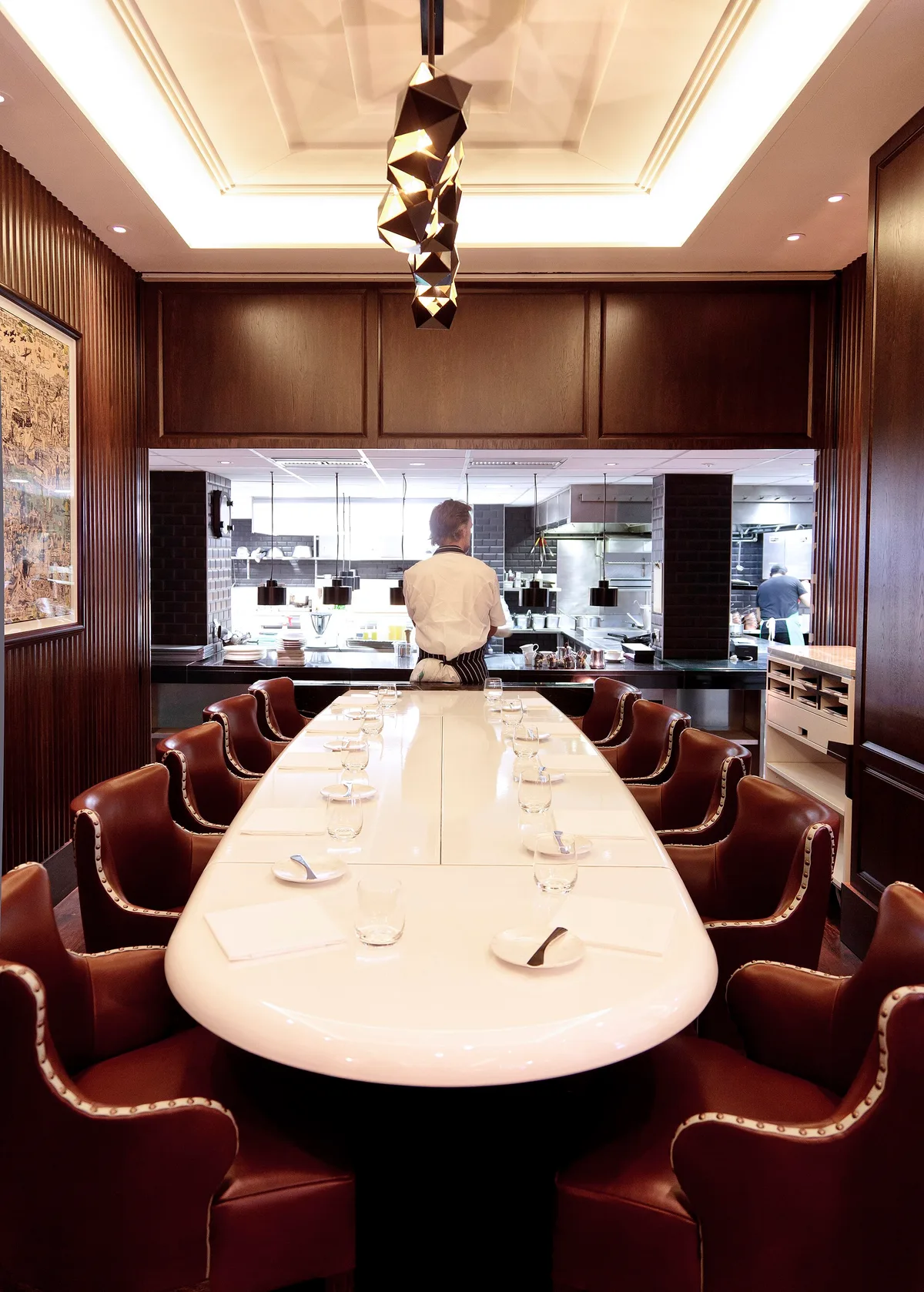
A chef's table is a seat placed inside or immediately beside the kitchen, where a small party watches the cooks work and eats a menu the kitchen builds around them. It is not a private dining room with a TV and a set menu. The defining feature is proximity: the pass, the stations, and the choreography of service are part of the show, and the chef or a senior cook often narrates the food as it lands.
The term gets used loosely, and that is where confusion starts. Some restaurants call any large corner table a "chef's table." Others seat guests at a counter facing the open kitchen without using the phrase at all. What separates a real chef's table from marketing is access: a menu that differs from the dining room's, a cook who explains each course, and a view of the kitchen that no other seat in the house gets. If none of those things is true, you have booked a nice table, not a chef's table.
New York has more of these seats than most cities, and they work differently from room to room. Some are literally inside the kitchen, past the pass. Some are counters where the brigade itself is the entertainment. Understanding what you are booking — and what the kitchen expects of you — is the difference between a memorable night and an awkward one.
What actually happens at a chef's table?
The evening runs on the kitchen's clock, not the dining room's. A tasting menu arrives course by course, often plate by plate as each dish is finished, so the pacing follows the cooks rather than a waiter's schedule. The person running the table is usually the chef de cuisine or a senior member of the brigade — the same hierarchy that decides who runs the pass in any professional kitchen, as our explainer on the kitchen brigade, station by station covers.
Expect narration. The point of the seat is context: what is in season, why a technique takes three days, what the kitchen is testing. Questions are welcome, though timing matters — mid-service, the cooks are plating a full dining room's orders while feeding you. The best guests watch, ask a few sharp questions, and let the kitchen work.
One practical note: kitchens are hot, loud, and bright. Dress casually comfortable rather than for the dining room next door, and expect to be seen as much as to see. You are sitting in the staff's workplace.
Why do restaurants offer a chef's table at all?
Money is part of it. A handful of seats at a premium price, sold to one party a night, generates strong revenue from square footage that would otherwise hold a prep station. But the better answer is control. A chef's table lets a kitchen serve exactly the food it wants — no ordering from a menu, no substitutions — at a scale where every plate goes out at its peak.
It also functions as a stage for the people behind the food. A chef's table turns the cooks into the face of the restaurant, which matters for a chef building a name. That career logic runs through a lot of New York dining: the profile of a chef-turned-restaurateur like Jean-Georges's Manhattan restaurant map shows how a cook's reputation compounds across rooms, and the counter seat is one of the cheapest ways a kitchen can tell its own story directly to the guests most likely to repeat it. This connects to our earlier piece, Why New York chefs cook staff meal first: the kitchen's own dinner, explained.
The chef's table is the one seat where the kitchen speaks for itself — no menu translation, no waiter in between.
How is a chef's table different from an open kitchen counter?
The two overlap, and many restaurants blur them deliberately. An open kitchen counter is a seating arrangement: you face the cooks, but you order from the standard menu and the kitchen cooks for the whole room, not for you. A chef's table is a program: a distinct menu, a dedicated host from the kitchen, and often a single nightly seating or a small number of seatings.
The test is simple. Ask what the menu is and who will be cooking for you. If the answer is "whatever's on the menu tonight" and "our servers," you are at a counter. If the answer is a tasting menu that changes with the market and a named cook, you have found the real thing. Some of the city's most sought-after counters — the kind of room where a reservation takes weeks, as our piece on how Tatiana became the hardest reservation in New York describes — sit somewhere in between, and that is fine. The label matters less than knowing what you booked.
What does booking one actually involve?
Three things differ from a normal reservation, and knowing them saves frustration.
- Headcounts are strict. Most chef's tables seat one party only — often two to eight people — so a no-show costs the kitchen its entire night's program. Deposits and card guarantees are common, and cancellation windows are shorter than the dining room's.
- Menus are fixed. Allergies and aversions need to go to the restaurant well ahead, sometimes days before, because the menu is written for your party specifically. This is not the place to announce a shellfish allergy at the door.
- Timing is the kitchen's. Seatings often start when the kitchen is least busy — early evening — so the cooks can give the table real attention before full service ramps up.
None of this is universal, and policies vary room by room. Read the restaurant's own booking page before you call, and confirm the menu, the headcount limit, and the deposit terms directly. Those details change, and this guide is a general explainer, not a snapshot of any one restaurant's policy.
Where did the idea come from, and why is it everywhere now?
The format has old roots in European fine dining, where chefs hosted valued guests in the kitchen as a mark of honor. What changed is the audience's appetite for watching work get made. Open kitchens became the default in ambitious restaurants, cooking shows normalized the kitchen-as-theater framing, and the chef's table sits at the far end of that arc: the guest fully inside the workshop.
Pop culture did its part too. The 2014 film Chef — a road comedy about a fine-dining cook who rebuilds his career from a food truck — grossed $49.8 million on an $11 million budget, according to Wikipedia's overview of the film, and its warm portrait of kitchen life, with chef Roy Choi overseeing the food, fed a decade-long appetite for stories set behind the kitchen door. The movie is fiction, but the appetite it rode is real: diners want proximity to the craft, and the chef's table is the industry's most direct way of selling it.
Our analysis: the format thrives because it solves two problems at once. Diners get a night that feels like access, and kitchens get a stage, a margin, and a menu with no compromises. Watch for the word being stretched, though — as chef's tables became a selling point, more restaurants borrowed the name for seats that don't earn it. The menu and the cook, not the name on the booking page, are what you're paying for. For related coverage, see Chef-owner economics: what it actually costs to put your name over the door in Manhattan.
Is a chef's table worth it?
Worth depends on what you want from a night out. If you want conversation with a date, a quiet corner, or control over what and when you eat, a chef's table is the wrong purchase — the menu is fixed, the room is loud, and the kitchen sets the pace. If you want to see how a serious kitchen thinks, taste food at the moment it leaves the pass, and hear a cook explain a dish in their own words, no other seat in the restaurant offers that.
The honest framing: you are not buying better food than the dining room gets. You are buying the version of the meal the kitchen would cook for itself, plus the story of how it was made. For the right diner, on the right night, that is the best seat in the house. For everyone else, the dining room two feet away is very good too.