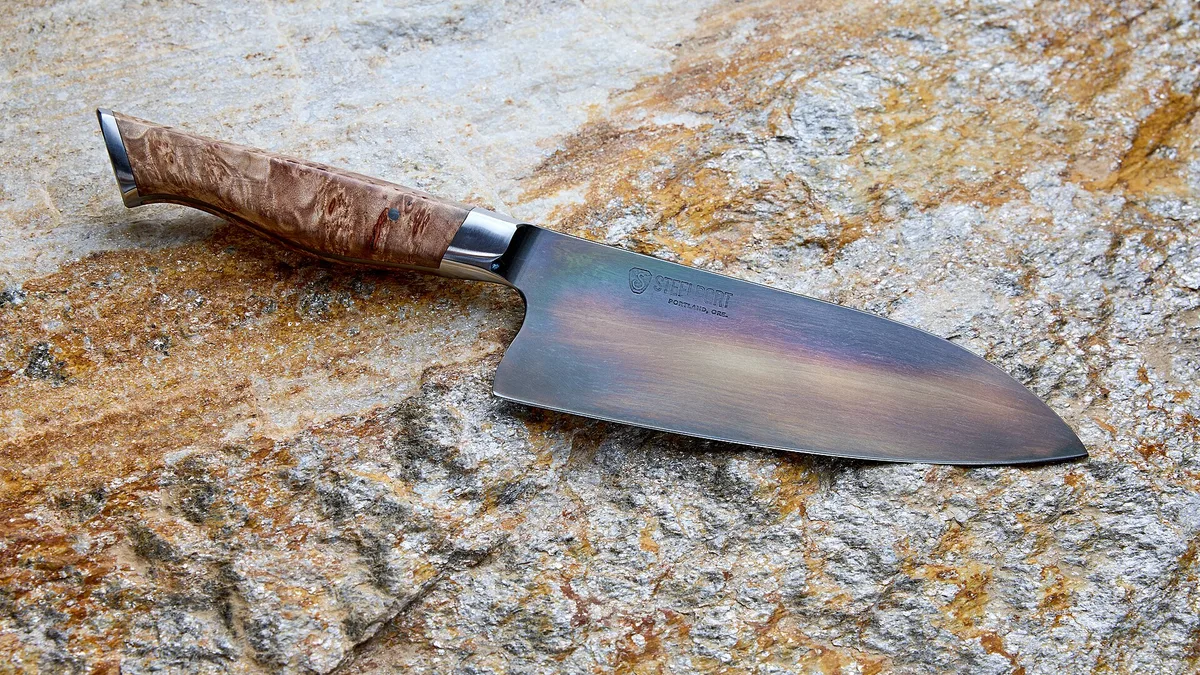
Walk into any restaurant kitchen in New York and you will see the same thing: cooks carrying their own knives in rolls and cases, knife to cutting board, shift after shift. A chefs knife is the one tool a professional owns outright, and the way pros pick one comes down to three things — the steel, the balance, and the shape of the edge. Price and brand logos matter far less.
The good news is that the professional method works just as well for a home cook. You do not need a block of twelve knives. You need one well-chosen chefs knife that fits your hand, your cutting board, and the way you actually cook. The word itself is a small trap for new cooks: Dictionary.com notes that "choose" is the present tense and "chose" the past — so you choose a knife once, and you chose well if you're still using it a decade later.
This guide walks through those three decisions in order, explains where the marketing hype lives, and finishes with a simple way to test a knife before you buy.
What is a chefs knife, exactly?
A chefs knife is the all-purpose blade at the center of a kitchen. It handles most of the daily work: slicing onions, breaking down herbs, cutting meat into portions, dicing vegetables. Most blades run between about six and ten inches long, with eight inches the common middle ground for home cooks. Shorter blades give you more control in a small kitchen; longer ones cover big produce like melons and winter squash. Readers following this should also see What a chef stage taught them: how New York cooks use short stints to change direction.
It is not the only knife worth owning. A paring knife handles small, in-hand work like peeling garlic. A serrated bread knife saws through crusts a straight edge will crush. But if a kitchen has one good knife, this is the one. For a look at how the professionals who wield these knives actually train and climb, see our guide on how to become a chef in New York. We covered a connected angle in Why New York chefs cook staff meal first: the kitchen's own dinner, explained.
How does steel change how a knife performs?
Steel is where most of the real differences between knives live, and it comes down to a trade-off. Softer steel is easier to sharpen and more forgiving — it bends a little under stress instead of chipping. Harder steel holds a sharp edge much longer, but it can chip if you twist it, drop it, or hit a bone, and it takes more patience to sharpen.
Most Western knives use softer stainless steel, which resists rust and tolerates rough treatment. Many Japanese knives use harder steel that takes a finer, keener edge, sometimes in carbon steel, which can discolor and needs a quick dry after every use. There is also high-carbon stainless, a middle path that aims for edge retention without the rust worries of plain carbon.
Practical steps for a home cook: if you hate maintenance, lean stainless. If you love the ritual of a whetstone and want the sharpest possible edge, a harder Japanese-style blade rewards you. If you cook a few times a week and want one knife that shrugs off everything, high-carbon stainless is the safe middle.
Why do balance and handle matter as much as the blade?
A knife is a lever, and where its weight sits changes how it feels after twenty minutes of dicing. A balanced knife — one where the blade and handle roughly counterweight each other at the spot where your fingers grip — feels lighter than it is, because your wrist isn't compensating. A blade-heavy knife chops with momentum; a handle-heavy one gives fine control. Neither is wrong, but one will suit you.
Handles come in wood, composite, and molded plastic. What matters more than material is shape: a handle that fills your grip without hot spots. Hands differ, which is why the single best test is holding the knife. A blade that feels perfect in a friend's hand can feel clumsy in yours, and no review can substitute for your own grip.
What should you know about edge geometry?
Edge geometry is the invisible spec that separates a good knife from a great one. Western blades are usually sharpened on both sides to a double bevel, with a bit of curve near the tip that lets you rock the knife on the board — handy for herbs and quick mincing. Many Japanese blades are ground thinner, sometimes with a flatter profile for precise push-cuts, and some traditional styles are single-bevel, sharpened on one side only for exacting work.
Thinner edges slice better — they push apart fewer fibers as they pass through food. Thicker edges survive abuse better. For a home cook, a moderate double-bevel edge is the versatile default. The angle also affects sharpening: a shallower angle cuts more keenly but is more fragile, which loops back to the steel trade-off above.
What this means for your buying decision
Our analysis of how professionals actually buy comes down to a short checklist:
- Decide your maintenance appetite first. It determines your steel.
- Hold the knife before you buy. Balance and grip are personal.
- Choose a moderate size — around eight inches suits most home kitchens.
- Ignore Damascus patterns, celebrity stamps, and knife-block bundles. They add cost, not performance.
- Budget for a honing rod and plan on periodic sharpening. A dull good knife is worse than a sharp cheap one.
One honest limit: no knife makes anyone a better cook on its own. Technique does that, and technique comes from repetition — the same reason line cooks spend years on stations before they run a pass, as our kitchen brigade explainer lays out station by station. A sharp, comfortable knife just makes the repetitions pleasant.
The takeaway: buy once, maintain forever
A chefs knife is one of the few kitchen purchases where a thoughtful choice pays off for a decade or more. Get the steel right for your habits, check the balance in your own hand, and pick an edge profile that matches how you cut. Then maintain it: hone often, sharpen when honing stops working, and never put it in the dishwasher.
The professionals' secret isn't an expensive knife. It's a well-matched one, kept sharp. Choose with that in mind and the rest of your knife drawer can wait.