A stage — pronounced “stahzh,” from the French for internship — is the restaurant industry's working audition: a candidate spends a service or a full prep day working a station in a real kitchen while the chef de cuisine quietly grades everything from knife cuts to how they hold the last hour of service. In New York, where the restaurant industry hires at a scale few other industries match, staging is the default hiring mechanism in serious kitchens: before a line cook gets a standing offer at a respected Manhattan room, a stage comes first, typically two to six hours, occasionally a full double. Here is how the system actually works in 2026 — what kitchens evaluate, what candidates owe and are owed, and where the law draws the line.
One boundary note before the mechanics: this site publishes information, not legal advice, and the employment-law summary below is a general picture of federal and New York rules rather than guidance for any specific dispute.
Where did staging come from?
The stage descends from the European brigade tradition, where a young cook would work unpaid in a great kitchen for the learning alone — the classic French apprenticeship model. New York imported the format and made it transactional: the kitchen gets a free look at a cook under real conditions, and the cook gets a look at the food, the team, and the chef before accepting an offer. In the modern city the stage is short — hours, not months — and concentrated in the craft-driven middle of the market, where the cooking is technique-heavy and the chef's standards are the product.
What actually happens on a stage
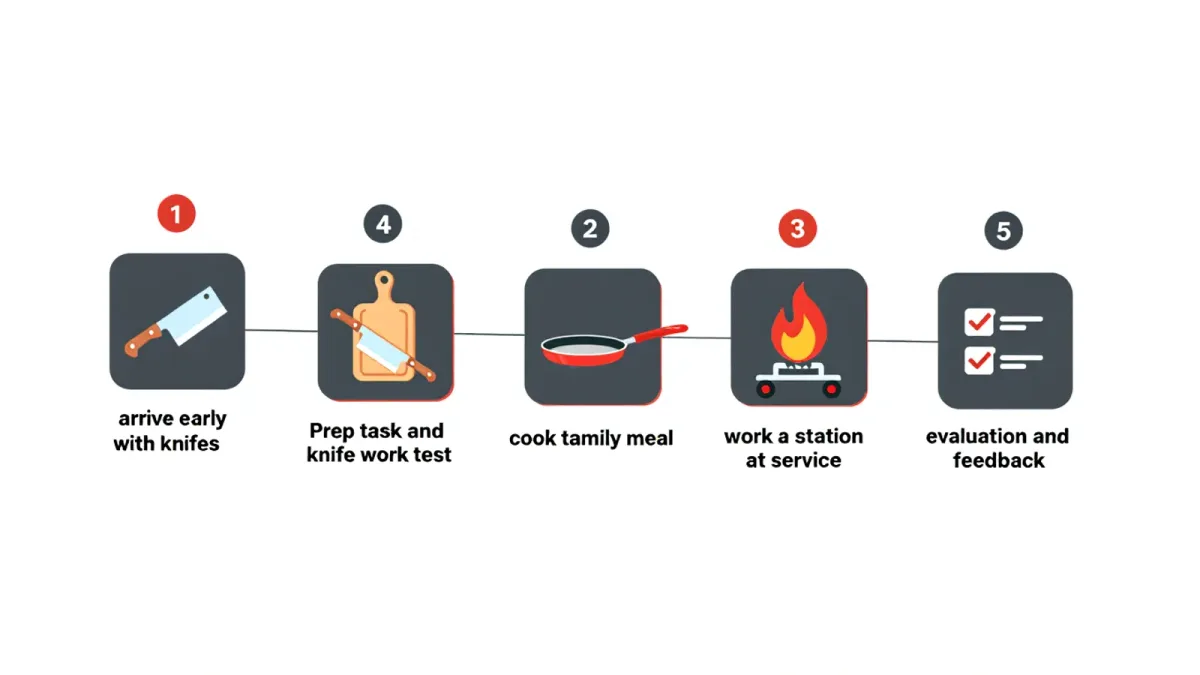
The choreography is consistent across Manhattan kitchens. Arrive early, in whites with knives, and ask for the chef or the sous. The trial usually starts in prep: a butchery or knife-work task, a sauce, maybe a family meal — the staff meal is a classic stage test, because it asks a stranger to cook something real from what is on hand. Then service on a station, usually with an experienced cook plating alongside. The evaluation never pauses: knife skills are read from the cutting board before the first task ends; cleanliness from the station; speed from the trash bag and the hotel pans; temperament from how the cook takes corrections. Chefs consistently weigh attitude over polish — a skilled cook who argues will lose to a lesser cook who absorbs a note and adjusts.
Is a stage legal, or is it unpaid labor?
This is the line that matters. Under federal law and New York labor rules, the balance runs on whether the primary beneficiary of the shift is the trainee or the employer: a structured learning stage, where the candidate does test tasks and the kitchen gains little productive work, sits on the legitimate side; a “stage” that is really an unpaid week of productive line shifts during a busy season is not, and wage claims over misused stages have been a recurring source of disputes and litigation in New York restaurants for years. The practical standard in the city's well-run kitchens in 2026: short, task-based, and paid as soon as the stage starts producing real work — many operators now simply pay stage shifts at prep-cook rate to keep the question closed. Candidates asked to stage a full productive week unpaid should treat that as a fact about the employer.
How to stage well
The candidate checklist, in order of weight. One: be early and self-sufficient — bring your own knives, whites, and side towels unless told otherwise. Two: keep your station clean continuously, not at the end; chefs read the board the whole time. Three: taste everything and say what you tasted — seasoning judgment is a core signal. Four: take the first correction fast and visibly; the second correction is usually the test. Five: ask real questions about the kitchen — mise en place systems, ordering, how service is staffed — because the stage is also your audit of the employer. Six: close well. The cook who leaves a clean station and says “what else can I do” is the one the sous remembers when the schedule is built.
The variants: trail shifts, paid tryouts, and the paid-audition norm
Not every tryout is called a stage. Hotels and large restaurant groups run structured “trail shifts,” often paid from the first hour, because their legal teams want the question closed. Some kitchens do working interviews at catering events, where a cook spends a shift at an off-site station — same evaluation, different room. The direction of travel across the city’s better employers is toward paid tryouts: the stage survives as a short mutual audition, but the era of the week-long unpaid trial is ending, pushed by wage enforcement and by cooks themselves, who talk — and a kitchen known for exploiting stages finds its line applications drying up.
What a stage should never be
Three red flags, from the candidate's side. A multi-week unpaid “trial” is not a stage; it is free labor. A stage in a kitchen with no teaching — no feedback, no structure, just a station in a shorthanded service — is extraction dressed as opportunity. And a kitchen that stages a string of candidates every week during peak season is running an unpaid staffing program, not a hiring process. New York's best kitchens stage selectively and pay quickly, and they are, not coincidentally, the kitchens where cooks actually want to work.