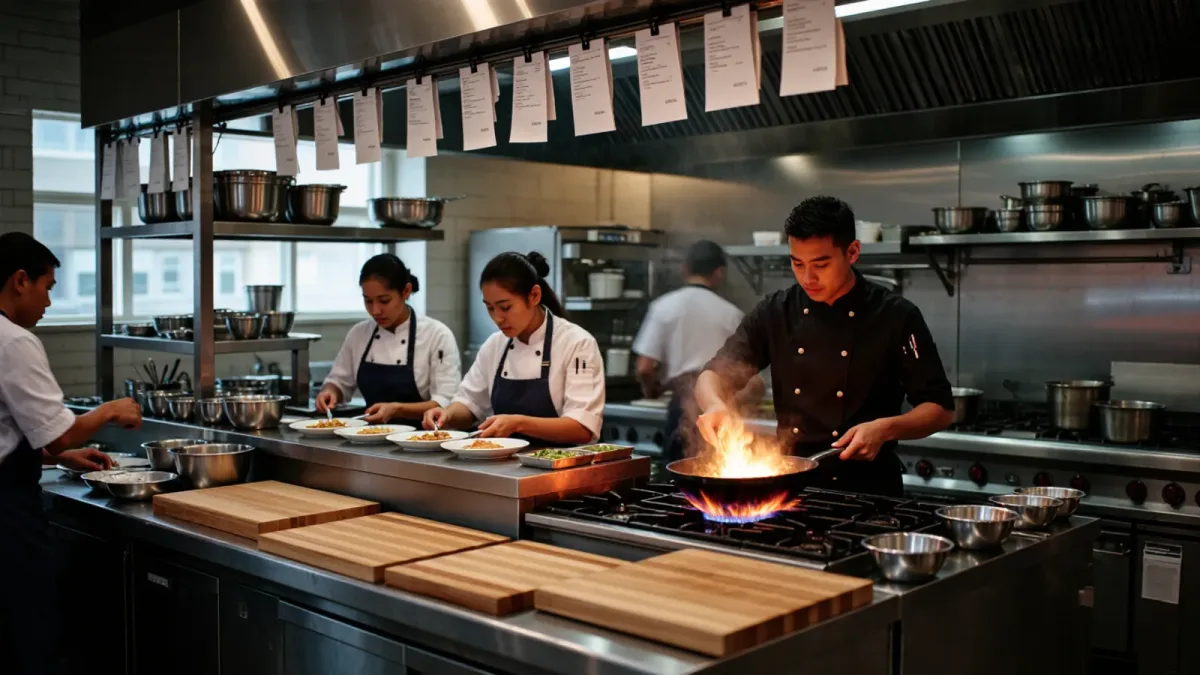
The path to becoming a chef in New York runs through a ladder that has barely changed in fifty years: dishwasher or prep cook, then line cook, then sous chef, then chef de cuisine — a climb that typically takes eight to twelve years in the city's serious kitchens. Culinary school can shorten the early rungs but does not skip them; New York's restaurant industry, one of the largest private employers in the city, hires tens of thousands of kitchen workers a year, and most of its best-known chefs started at the bottom of the dish pit. Here is how the ladder actually works in Manhattan kitchens as of 2026, rung by rung, with the timelines and the honest odds at each stage.
This site publishes information, not career advice — the timelines below are drawn from how the industry's structure works, not a promise about any individual path.
What is the first rung, and do you need school to reach it?
The entry points are dishwasher, prep cook, and — for those with some training — line cook. New York requires a food protection certificate for food-service supervisors, a course and exam run by the city's health department, but no license is needed to start cooking. Culinary school is a genuine accelerator: a diploma signals knife skills and food-safety literacy, and school-run externship programs place students in professional kitchens before graduation. But the industry's own tradition runs the other direction too — many of the city's most decorated chefs never attended school and came up through the line. The practical rule: school buys contacts and technique, the kitchen buys everything else.
Prep cook: the real apprenticeship
Prep cook is where careers are actually built. The work is peeling, butchering, batching sauces, and learning a kitchen's recipes from the inside out, typically at modest hourly pay, for one to three years. What separates the promotable prep cooks from the rest is reliability across services and speed that holds without quality collapsing — the two things every chef de cuisine tracks. This is also the stage where staging, the unpaid or low-paid trial shift that the industry uses as a mutual audition, comes into play; ambitious prep cooks stage at better kitchens to move up.
Line cook: the station system
The line is organized into stations — commonly garde manger (cold), sauté, grill, fry, and pastry — and a line cook masters stations one at a time, typically spending six months to two years at each before moving. Promotion on the line is earned at service, on the pass. A line cook who can run any station, close the kitchen cleanly, and train a newcomer is next in line for sous chef. Expect the whole line phase to run two to five years. In Manhattan, the line is also where the industry's economics get personal: wages remain modest, hours run 50-plus a week, and the kitchens that retain cooks are the ones that build schedules around that reality.
Sous chef: the management switch
Sous chef is where the job changes from cooking to running. A sous chef orders product, manages staff schedules, enforces food safety, controls food cost, and cooks only as much as management allows — typically two to four years in the role before a chef de cuisine or executive chef seat opens. The city's health department requires the food protection certificate for supervisors at this level, and most operators expect it before the promotion, not after. The honest odds: not every great line cook becomes a good sous chef, because the skills only partially overlap. The best cooks follow recipes; sous chefs follow labor costs, deliveries, and people.
Chef de cuisine and beyond
The chef de cuisine runs one kitchen: menu, brigade, cost, and quality, usually reporting to an owner or a chef-owner above. From there the paths fork — executive chef across multiple kitchens, chef-owner with a room of one's own, or the specialty tracks in pastry and beverage that run on parallel ladders. Titles in New York are not standardized; the same title can mean different scopes at a 60-seat trattoria and a hotel group. What travels is the record: which kitchens, which stations, which years.
Where the jobs actually are
New York's kitchen jobs are not evenly distributed, and neither is career value. A year on the line at a rigorous, well-run Manhattan kitchen teaches faster than three years at a place where the menu never changes, which is why ambitious cooks trade pay for resumes — a calculated move, since the city's hiring runs on references and the record of the rooms. High-volume hotel kitchens teach consistency and systems; small chef-driven rooms teach craft and menu development; both are legitimate first chapters. The practical map: find kitchens whose chefs cook the food you want to cook, accept the modest wage, and leave when the learning curve flattens — not before, and not long after.
How long does the whole climb take?
Counting from the first paid kitchen job, the standard Manhattan timeline runs: one to three years in prep, two to five on the line, two to four as sous — roughly eight to twelve years to a first chef de cuisine title, faster in small rooms and faster for cooks who stage deliberately and move when the learning stalls. The rate-limiting factor is rarely talent; it is the number of quality kitchens a cook can afford to work in while the pay is still modest. That arithmetic, more than anything else, is what New York's aspiring chefs manage.