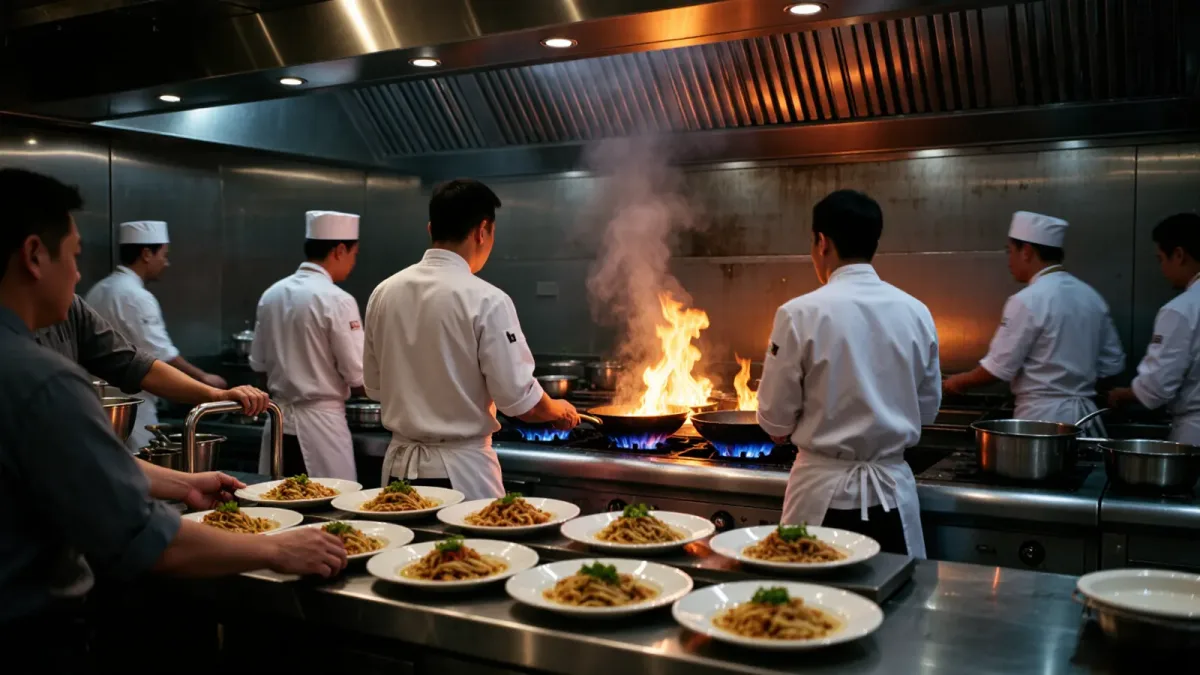
Every serious Manhattan kitchen runs on a command structure imported from France more than a century ago: the brigade system, in which a chef de cuisine owns the room, sous chefs enforce it, station chefs — chef de parties — cook it, and an expo calls the tickets that bind the whole floor to the dining room. The vocabulary survives untranslated in New York kitchens, and understanding it explains everything a diner watches at a pass: why one cook plates, one finishes, and one runs the food. As of 2026 the system remains the industry's default in the city's serious rooms, though with modern changes worth knowing. Here is the brigade, station by station, top to bottom.
What is the brigade system?
Georges Auguste Escoffier codified the brigade de cuisine in the late 19th century, adapting military hierarchy to hotel kitchens: a chain of command where each station owns a defined job, so a large kitchen can produce hundreds of consistent plates a night. New York's hotel and fine-dining kitchens run the classical version nearly intact; smaller chef-driven rooms compress it into three or four roles wearing several hats. The system's virtue is repeatability under pressure — the reason it persists even as the industry modernizes its labor practices around it.
Chef de cuisine and sous chefs: the command tier
The chef de cuisine runs one kitchen — menu, brigade, ordering, and quality — reporting to an owner or chef-owner. Below them, sous chefs execute: one sous typically runs the savory line at service while another handles ordering, staff scheduling, and food safety paperwork. In Manhattan's larger rooms, the sous tier also runs the kitchen's bureaucracy — the health department's food protection certificate requirement applies to supervisors, per the city's posted rules, and the sous chefs hold it. The distinguishing skill of the tier is not cooking but communication: a sous's job is translating the chef's standards into the line's night.
The stations: chef de partie, defined
The line's specialists each own a station. Garde manger runs the cold station — salads, appetizers, terrines — and often trains new cooks. Saute and grill own the hot lines, cooking proteins and pan work to order. Poissonnier handles fish; friturier runs the fryer; entremetier covers vegetables and soups; rotisseur the roasts, where the station still exists. Tournant is the swing cook who fills any gap — the most valued generalist on the line. A mid-size Manhattan room runs four to six of these stations; a hotel kitchen runs the full classical board. The stations explain the kitchen's choreography at the pass: each ticket fires to multiple stations in sequence, and the expo decides when the plate comes together.
Expo: the kitchen's air-traffic control
Expo — the expediter — stands at the pass between kitchen and servers, reading tickets, calling fired items, holding or cutting dishes, and inspecting every plate before it leaves. In most New York kitchens the chef de cuisine or a senior sous runs expo at service; in others it is a dedicated role. The job is the room's bottleneck and its quality gate at once, which is why cooks describe it as the hardest seat in the building: expo owns the tempo of both the kitchen and the dining room, and a good one finishes every table's food at the same temperature and the same minute.
The modern additions: pastry, stewarding, and front coordination
The savory brigade sits inside a larger structure. The pastry section runs as a parallel brigade with its own sous and stations. Stewarding — the dish pit and pot sink, run by a steward — is the kitchen's logistics backbone, and Manhattan's better operators now treat the stewards' crew as a career entry point rather than a dead end, a shift visible in the industry's hiring language over the last decade. And front-of-house coordination has tightened: many rooms seat a server manager or chef's liaison at the pass to translate the dining room's pace, an adaptation the classical brigade never needed when servers were fewer and menus shorter.
How the system changed for labor
The hierarchy's vocabulary survived, but its labor model has been rebuilt over the last two decades. New York's wage rules — the city's minimum wage rose to $17.00 per hour on January 1, 2026 under the state's posted schedule — and the industry's post-2020 staffing shortage pushed operators toward scheduled overtime discipline, standardized prep, and the elimination of the unpaid trial abuses that the old apprenticeship culture tolerated. Titles flattened in the chef-driven middle: many rooms now run 'line cook 1/2/3' scales instead of French station names, and service-included models reshaped the tip hierarchy that once underpaid the back of house. What did not change is the direction of authority at service — the pass still rules — only the compensation and the contract around it.
Why the vocabulary still matters to diners
Reading the brigade explains what you are watching from the dining room. The cook plating with tweezers is a chef de partie finishing at the pass; the voice calling numbers is expo pacing the room; the person tasting from a spoon before the plate moves is the sous enforcing a standard. It also explains the industry's career ladder, because every Manhattan chef de cuisine climbed through these stations — the structure is the ladder. When a kitchen slows on a Saturday night, the vocabulary tells you where the failure is: not the cooking, but the coordination at the pass.