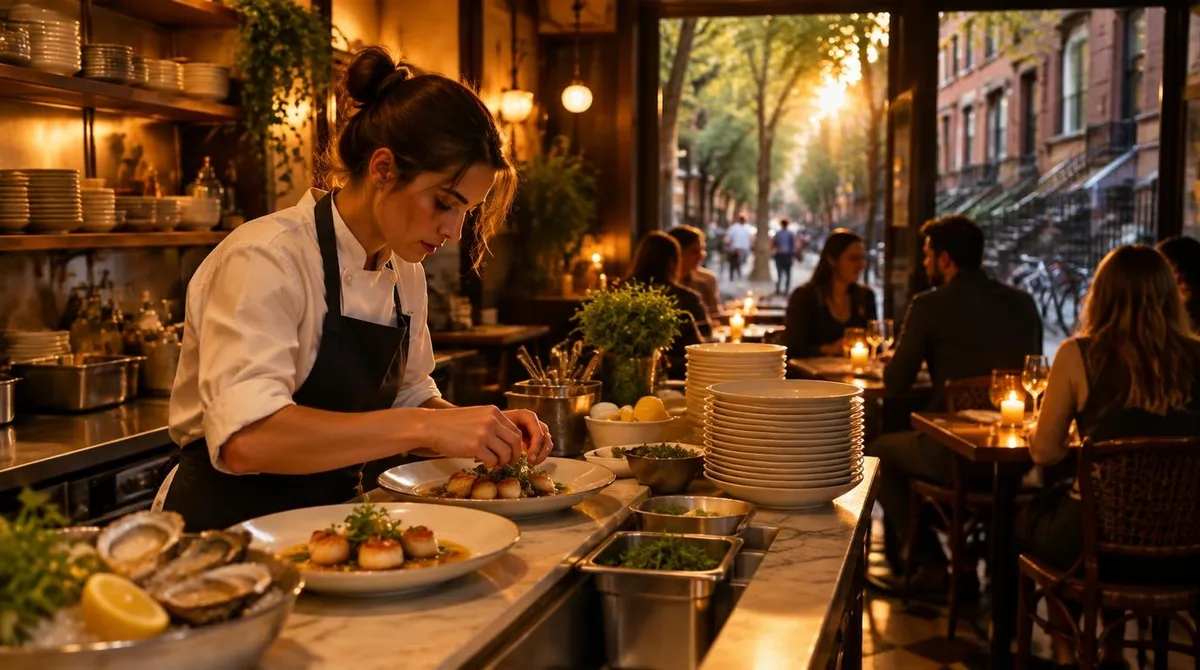
A chef residency is a short run in someone else’s kitchen, and in New York it has become the audition before the lease. Patricia Howard and Ed Szymanski started Dame as a pop-up in March 2020. By June 2021, the pair had opened the permanent room at 87 MacDougal Street with 24 seats.
Chef residencies work as tryouts. The host fills slow nights with someone else’s cooking. The guest tests a menu, a neighborhood, and a price point before committing to rent. The model rewards both sides, which is why the pattern keeps showing up on blocks where a full buildout would be a gamble.
What exactly is a chef residency?
Per InsideHook, pop-up programming has become more and more prevalent as chefs at every career stage loosen their attachment to a single kitchen. Jay Wolman runs Intermission, a nomadic project built on that looseness. “It could be a week, it could be a month,” he told the outlet. In 2024, he wrapped a month-long turn at the snug London wine bar 107, formerly P. Franco, after stops in Brooklyn, Marseille, and Brussels.
Wolman’s summary of the format doubles as a job description. “Great chefs no longer need to be attached to a restaurant to be busy,” he said. A residency borrows a working kitchen, its equipment, and its address. The guest brings a menu and a following. Nobody signs a ten-year document.
How did Dame’s pop-up become a restaurant?
The West Village seafood room is the case study. Howard and Szymanski ran a series of pop-up dinners to show the Dame concept to potential investors, per Columbia College Today. Covid shut the plan down, so the couple relaunched the pop-up as a fundraiser for Black Lives Matter and pivoted to takeaway seafood. By the end of that summer, the project had raised $20,000, and the pair were ready for a brick-and-mortar room.
The alumni magazine dates the opening to June 2021 at 87 MacDougal Street, right next to where the pop-up had stood. With just 24 seats, a Dame reservation became one of the hardest tickets in the city. The pop-up had already done the market research. The lease only added tables.
Who pays for what in a residency?
Deals vary, and operators rarely publish their splits. The shape stays consistent. The host covers the room, the equipment, and often the back-of-house staff, then takes a share of the night’s sales. The guest prices a menu that has to clear food cost and labor inside a short window, without a buildout loan hanging over the pass.
The stakes stay personal. Ari Miller, who closed his Philadelphia room Musi BYOB and later cooked at Ivan Ramen in New York, put the baseline plainly to InsideHook: “Ultimately, you have to pay your rent, you have to buy yourself food.” A residency shrinks both lines on that ledger. It does not erase them. This connects to our earlier piece, What a chef stage taught them: how New York cooks use short stints to change direction.
When does a residency turn into a lease?
When the numbers hold for a run of weeks, the permanent room follows. Dame’s arc continued at speed: Lord’s, the English bistro the couple opened on October 3, 2022, grew out of a nearby space that came available in the spring of that year, per Columbia College Today. Crevette followed in February 2025. Howard keeps the timeline in perspective in her Resy interview: “restaurants are a long game.”
Intermission stays nomadic on purpose, and that is the second exit. A residency can be a destination rather than a door. For cooks without investors, though, the path from guest nights to a signed lease now has a mapped example on MacDougal Street.
Conclusion: the tryout before the lease
Chef residencies let a kitchen prove demand before the rent starts, and New York keeps supplying the evidence. A February-to-June arc in the West Village turned a paper-boat pop-up into a 24-seat restaurant and then into a three-room group. For a chef holding a menu and no address, a residency is the cheapest answer to the question every landlord asks. Will anyone come? For related coverage, see The stage, explained: how New York kitchens run the tryout shift that decides who gets hired.