Manhattan does not have one pizza culture; it has four, and they live on different blocks. The counter-slice pizzerias of Midtown and the Village, the Neapolitan dining rooms that spread from Downtown after 2004, the Sicilian and grandma squares of the old neighborhood shops, and the wood-fired middle that now occupies the trend blocks — each has its own economics, its own clock, and its own correct order. A plain slice runs roughly $4 to $6 at the counters as of March 2026, a Neapolitan pie $16 to $24, and a grandma square $5 to $7 a square; this guide maps all four styles to their home turf and tells you what to order when you get there.
What is a New York counter slice?
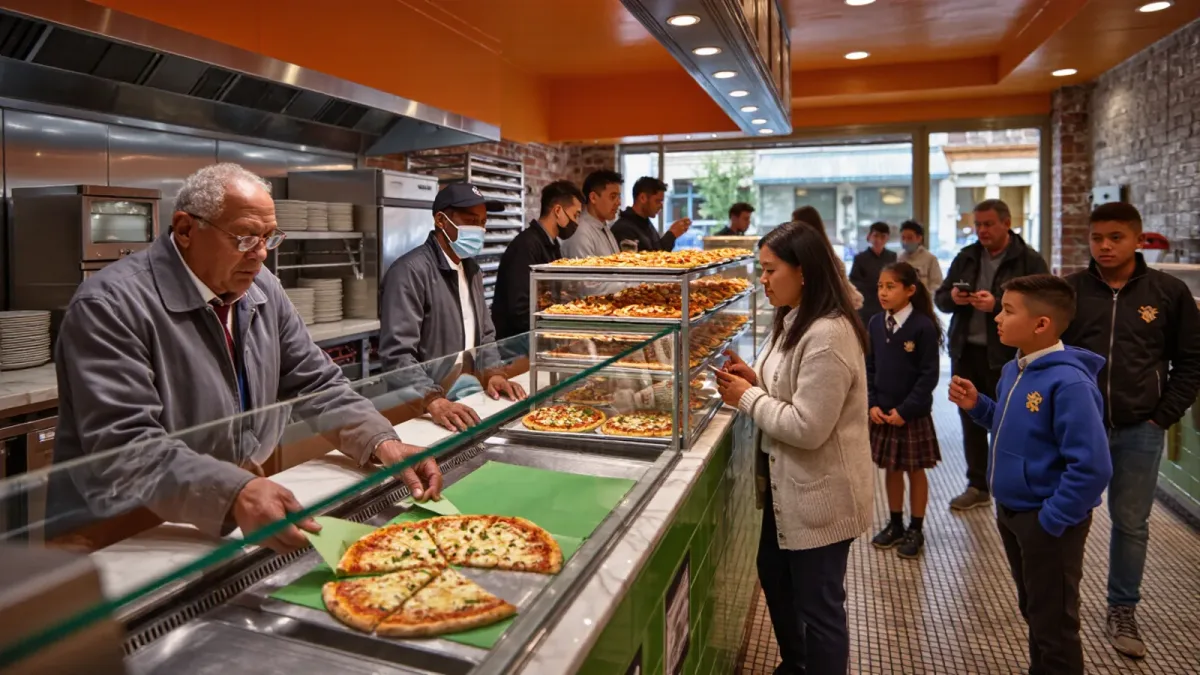
The native style: an 18-to-20-inch pie baked in a gas deck oven, sold by the slice, foldable, with a thin crisp undercrust and a thin sauce line. The style descends from the Neapolitan emigrants who adapted their dough to American deck ovens a century ago — the city's first pizzeria, on Mulberry Street in 1905, started that lineage. The counter slice survives on volume: a shop that empties its rack every 20 minutes serves a better product than a shop baking to order for a trickle of customers, because the deck oven runs best continuously. Order the cheese slice plain — the undercrust is the point — and fold it. The format's strongest blocks are around Midtown's lunch corridors and the Village's late-night strips.
Neapolitan: the dining-room import
The second culture arrived as a sit-down movement: 12-inch personal pies, 60-to-90-second bakes in 900-degree wood or gas dome ovens, soft leopard-spotted crusts, and toppings in the Italian canon. The movement's Manhattan anchor blocks are in the East Village and Nolita, where the pioneering Neapolitan rooms of the 2000s still draw lines, and the style now spreads through almost every new dining strip on the island. The format is a restaurant, not a counter: expect a table, a wait, and a per-pie price in the $16-to-$24 band. Order one pie per person — these are personal sizes despite the menu's confidence — and eat it in the first three minutes, because the wet Neapolitan center sets as it cools.
Grandma and Sicilian: the square bloc
The square tradition runs through the old neighborhood shops — a rectangular pan pie, olive oil in the pan, sauce on top of the cheese for the grandma style, sauce under for the Sicilian, baked in a gas deck oven in a sheet pan and sold by the square. It is the home-cooking style of the Long Island and Brooklyn family kitchen, transplanted to the island's older shops, and it carries the best reheat economics in the city: a square from the afternoon tray, re-baked until the bottom snaps, outclasses anything in a warming case. The style's redoubts are the East Side's old counters and the family shops around Chelsea and the Lower East Side; $5 to $7 a square buys the most structured bite in the taxonomy.
The wood-fired middle
The fourth culture is the current one: chefs trained in the Neapolitan canon loosening the rules — longer fermentation, mixed flours, bar-style round pans, coal ovens alongside wood — at rooms that behave like restaurants and price pies like restaurant courses, $18 to $28. These rooms cluster where new restaurant rows form: the Avenue B corridor, the Hudson Square edges, the northern blocks of Hell's Kitchen's Ninth Avenue strip. The order that works: skip the novelty topping for the house plain pie, which is the kitchen's thesis statement, and judge the dough by the rim, not the center.
When each style eats best: the clock of the four cultures
Pizza styles in Manhattan keep different hours, and timing is half the order. The counter slice peaks at three windows — the 12:30 office rush, the 6:30 pre-event crush, and the post-midnight Village crowd — and the deck oven's continuous bake makes those peaks the freshest moments of the day. Squares are a mid-afternoon food: the lunch trays bake late morning and reheat beautifully around 3 p.m., when the shops are quietest. Neapolitan rooms are a 7:30 dinner culture, table-paced and reservation-tilted, though the wood-fired middle now runs bar service that takes walk-ins. Match the style to the hour and even a modest shop serves its best possible version of itself.
How to read a Manhattan pizza counter in ten seconds
Three tells, drawn from the trade's own logic. Rack turnover beats freshness theater — a busy counter with a half-empty rack is a better bet than an empty shop with a full one. Oven type predicts style before you see the pie: a gas deck row means the foldable slice, a dome means Neapolitan, sheet pans mean squares. And price discipline is real: a counter that raises the plain slice a dollar without changing the dough has answered the question of why you were there. As at every counter in this city, the health department's posted inspection records are public for any address, and they are worth as much as any line-out-the-door signal.