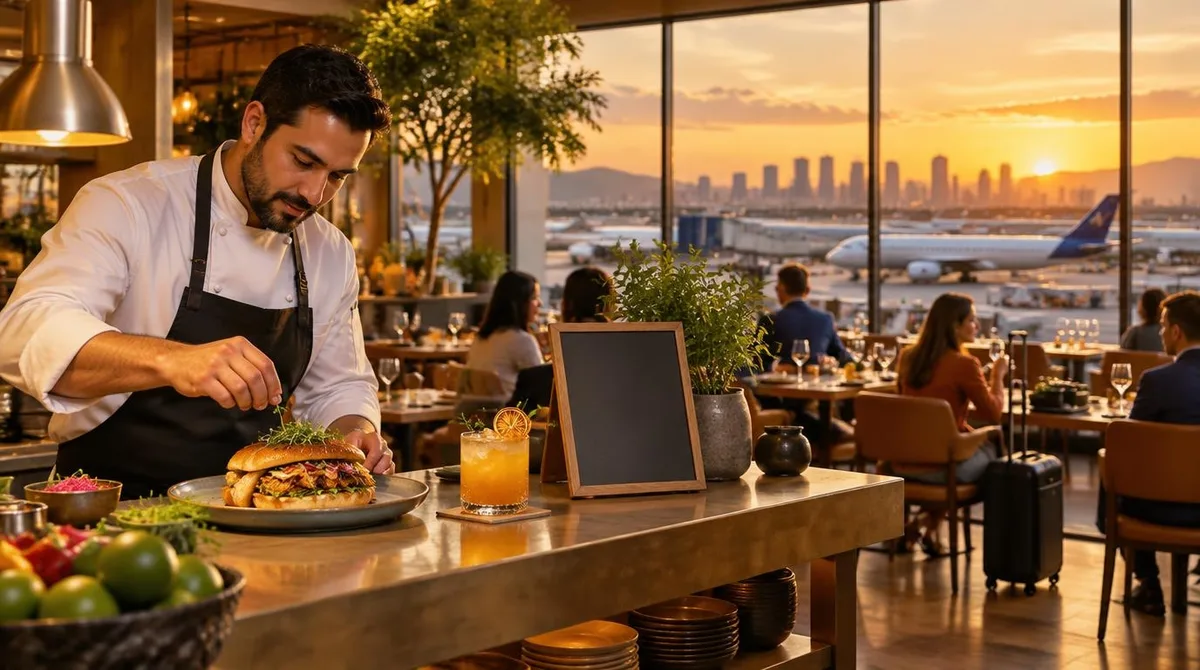
For years, the airport restaurant meant one thing: a captive audience and a mediocre menu. You paid more because you had nowhere else to go. That deal has changed. A growing number of terminals now carry restaurants built by chefs with real reputations on the ground, and some have become reasons to show up early rather than excuses to grab whatever is closest to the gate.
The shift is easiest to see in a handful of named places. At Atlanta's Hartsfield-Jackson, One Flew South opened in 2009 in Concourse E as a standalone fine-dining room, a deliberate contrast to the franchise counters around it, blending Southern cooking with Japanese tradition. At Chicago O'Hare, chef Rick Bayless built Tortas Frontera, a Mexican sandwich spot with multiple locations across the airport. These are not rebranded fast food. They are actual restaurants that happen to sit past security.
What does chef-driven actually mean at an airport?
It means the kitchen answers to a named chef or an established restaurant group, not only to a concession contract. The menu is written by people who cook for a living, and the food is built to the same standard as their street-level locations. At Tortas Frontera, the headliners are the tortas — large Mexican sandwiches — alongside tacos, quesadillas, soups and salads. At One Flew South, the sushi program runs from traditional rolls to Southern takes like the Cajun Roll, with shrimp, crawfish salad, Cajun sauce and panko, plus a collard green ramen that pushes the fusion idea further.
The distinction matters because airport dining has long run on a different incentive. A captive traveler will settle. A chef with a reputation to protect will not, at least not on the menu. That is the whole engine behind the trend: bring the accountability of a named kitchen into a place that historically had none.
Why did airports start caring about food?
Part of it is competition between airports themselves. Hubs now market their dining the way they market their lounges. According to Food Republic, a number of these restaurants have appeared on multiple "top airport restaurant" lists, to the point that they help make their airports destinations in their own right. When a layover can be a selling point, the concession contracts stop going automatically to the biggest franchise operator.
Part of it is travelers getting savvier. Frequent flyers talk, review, and route themselves around good food. A restaurant that earns national coverage becomes an asset the airport can point to. One Flew South has drawn years of praise from travel and food outlets, and in 2023 it ranked as the best airport restaurant in the world according to The Family Vacation Guide, as the source notes. Wine Enthusiast also named it one of the best seven airport bars in the world, before counting the food at all. For related coverage, see Food travel guide: How to plan a food-focused city break.
There is a legacy angle too. The Berghoff Cafe at O'Hare, near Gate C26 in Terminal 1, is an extension of a Chicago restaurant family that has been in the business since 1893. It reads as a scaled-down German beer hall, serving hot carved sandwiches, paninis and personal pizzas, with beer from the family's own Adams Street Brewery brand. Familiar names give terminals something a generic concession never can: a story a traveler already half knows.
Does chef-driven mean expensive?
Not necessarily, and this is where the trend gets interesting. Tortas Frontera keeps most items between $10 and $20, which the source calls firmly reasonable by airport standards. The Berghoff Cafe prices its larger sandwiches around $14 to $16, with a glass of beer at $12. At One Flew South, the source points out that the upscale room charges only a touch more than the TGI Fridays next door, which was charging $20 for a burger at the time of reporting.
The comparison is the point. Once a serious restaurant sits a few gates away, the pricing of the franchise counter stops looking normal. You are no longer choosing between bad and worse. You are choosing between a $20 airport burger and a chef's torta for less. That competitive pressure is quietly the most consumer-friendly thing the trend has produced. Our analysis: the quality bar rose faster than the price bar, at least at the places that made the lists.
For a deeper look at how terminal pricing works in general, see our breakdown of airport food prices and how to eat smarter on a layover. And if you are building an eating plan around a trip rather than a layover, our food-focused city break guide covers the ground game. This connects to our earlier piece, Airport food prices: why the terminal sandwich costs more, and how to eat smarter on a layover.
Which airports are worth planning around?
Three come up again and again in the source material. Atlanta's Hartsfield-Jackson has One Flew South in Concourse E, the fine-dining benchmark. Chicago O'Hare has both Tortas Frontera — near Gate B11 in Terminal 1, Gate K4 in Terminal 3, and Gate M18 in Terminal 5 — and the Berghoff Cafe in Terminal 1. Denver International has Root Down in Concourse C, an outpost of a popular Denver restaurant group that is fully employee owned, per the source.
- Atlanta (ATL): One Flew South, Concourse E. Sushi plus Southern-Japanese fusion. Upscale pricing, but competitive with the franchises beside it.
- Chicago (ORD): Tortas Frontera, three terminals. Fast casual with a famous chef's name on it, and the affordable pick.
- Chicago (ORD): Berghoff Cafe, Terminal 1 near Gate C26. Carved sandwiches and house-brand beer from a family business dating to 1893.
- Denver (DEN): Root Down, Concourse C. The local favorite, transplanted to the terminal.
Practical steps if you want to use this trend rather than just read about it: check the terminal map before you fly, not after you land at the gate. Note which concourse your restaurant sits in, because a good room in the wrong concourse is a missed connection waiting to happen. Build in buffer time — a sit-down meal needs the same runway at the airport as it does downtown. And if your layover is short, the fast-casual chef spots are built for exactly that problem.
What this means for the future of terminal dining
The evidence points one direction: the airport restaurant stopped being a monopoly and started being a market. When One Flew South opened in 2009, it was described as one of the first truly upscale airport restaurants in the United States. Fifteen-plus years later, chefs like Bayless run multiple outposts in a single airport, and legacy families extend their brands past security. The next question is not whether good food belongs in a terminal. It is which airports can attract the chefs, and whether the franchise counters can survive being compared to them side by side.
What remains unknown is how broadly this spreads beyond the hubs that made the lists. The restaurants above cluster at major connecting airports, where layovers concentrate hungry travelers. Smaller fields may keep the old model for a while. But the benchmark has been set, and travelers now know what a terminal can be. For more on how the dining scene moves, keep an eye on our Travel News coverage and the wider dining desk.