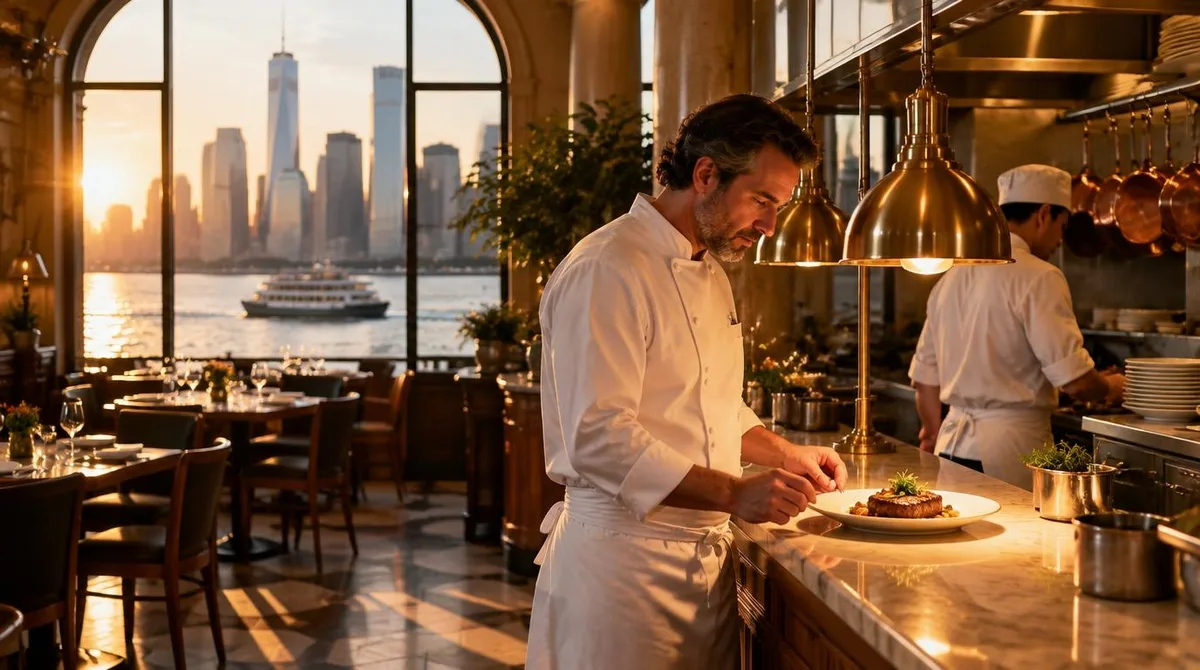
In a New York restaurant group, the chef does not belong to one kitchen. Adam Plitt, executive chef of Delmonico’s Hospitality Group, oversees the landmark Financial District dining room, a Midtown expansion, the Italian room Tucci, and the Boogie bakery uptown. Four rooms run on one culinary line.
Restaurant groups rotate chefs between kitchens because a shared standard is cheaper than a shared brand apology. Rotation holds the food steady across addresses, builds the next chef on the roster, and puts a tested leader in place the week a new room opens. The practice has winners and costs, and New York shows both. We covered a connected angle in Why New York chefs cook staff meal first: the kitchen's own dinner, explained.
Why do restaurant groups move chefs between rooms?
The clearest answer comes from the operators. When the group named Plitt executive chef in March 2026, owner Dennis Turcinovic framed the hire around continuity: “New York doesn’t need another generic steakhouse,” he told FSR Magazine, pointing to two centuries of New York culinary history behind the name. The group treats its standard as an asset. A rotating chef is how that asset stays intact across rooms.
The hire also shows what groups shop for. Per the same report, Plitt’s years leading the kitchen at Le Bernardin shaped his approach to fine dining, team development, and kitchen operations. Experience across kitchens is the resume line a multi-room group pays for.
What does the path look like for a cook?
Plitt mapped the ladder in a July 2026 interview with Total Food. He started at Le Bernardin as a cook, moved up to sous chef, then executive sous chef, and picked up a director of operations role in consulting along the way, supporting restaurant openings at Ritz-Carlton properties. He finished as chef de cuisine before taking an executive chef job outside the restaurant.
His own account of why the movement matters: kitchens at a young age, moving through hotel kitchens and country clubs, then restaurants, gave him what he called “a true feel for the business as a whole.” Inside a group, the same logic runs one floor apart instead of one borough apart. A cook who has prepped two menus adapts to a third faster.
What happens when a group opens a new room?
The rotation turns visible at openings. On October 15, 2026, the group opened Boogie Bakery & Bistro at 4015 Broadway in Washington Heights, per FSR Magazine, with breakfast, lunch, and dinner six days a week and sourdough baked by hand all day in an open kitchen. The menu runs under the culinary direction of the same executive chef who oversees the Financial District flagship.
That is the model in miniature. One voice sets the standard, a new room borrows it from day one, and the neighborhood gets a kitchen that already knows the playbook. The announcement billed Boogie as a neighborhood restaurant first, and the bread is the calling card.
What does the rotation cost?
The trade is attention. An executive chef spread across addresses spends hours in transit and meetings that a single-room chef spends on the line, so the pass depends on strong sous chefs in every room. The group pays for depth below the title. The chef pays in split focus, and the kitchens pay in the discipline it takes to keep one standard without one body in the room. Readers following this should also see Chefs open small restaurants — Why chefs leave big kitchens to open small rooms: the sous-chef's leap, explained.
Operators accept the cost because the alternative prices higher. A group that lets each room drift develops four brands instead of one, and every drift shows up first on the plate.
Conclusion: one standard, many kitchens
Restaurant groups rotate chefs because consistency, training, and openings coverage all improve when cooks move between kitchens on purpose. Delmonico’s Hospitality Group runs the experiment in public: a Financial District landmark, a Midtown expansion, an Italian room, and a Washington Heights bakery share one executive chef and one standard. For cooks, the message is practical. The route to an executive title runs through more than one kitchen.