Jean-Georges Vongerichten operates roughly 60 restaurants worldwide, per his company's own count, and no chef has stamped a wider map on Manhattan: the two-Michelin-starred flagship Jean-Georges at Columbus Circle, the Nougatine café beside it, the abc trio in Flatiron, the downtown Midtown kitchens of the Mercer Kitchen era, and the Seaport's Fulton. The flagship's early run included a James Beard Outstanding Restaurant honor, and Vongerichten's own shelf holds the foundation's Outstanding Chef award — a 1998 tie with Wolfgang Puck — per Reuters' award coverage. Raised on the outskirts of Strasbourg in Alsace, trained in the classical French kitchens of Paul Bocuse and Louis Outhier, he arrived in New York in the mid-1980s and spent a decade in hotel and restaurant kitchens before the 1997 opening of his eponymous flagship rewired the city's fine dining. This is the documented timeline, drawn from the company's published biography and award records, as of June 2026.
A method note: this profile relies on documented public sources — the company's own materials and published award histories. No interviews were conducted, and no quotes appear beyond those in the public record.
Where did Jean-Georges train?
The biography starts in Alsace, in a restaurant family — his parents ran an establishment in a Strasbourg suburb, and the story he tells publicly is of choosing the kitchen over the dining room at 16. The classical training ran through France's brigade system: stages and sous positions under Paul Bocuse near Lyon and then Louis Outhier's L'Oasis on the Riviera, two of the defining kitchens of postwar French cooking. A shipboard apprenticeship across Asia followed, and the flavor grammar he picked up there — ginger, chiles, herbs in place of butter and cream — became the signature that later made his New York cooking identifiable on first bite: French technique with Asian aromatics, lighter than the era's haute cuisine.
New York before the flagship: Jojo, Vong, and the hotels
Vongerichten arrived in New York in 1986 and worked the hotel kitchen circuit before opening Jojo in 1991, a small East Side room that introduced his lighter, aromatic French cooking to a critical audience. Vong followed in 1993, pushing the Thai-French fusion further, and the Mercer Kitchen in 1998 put his cooking under the SoHo hotel crowd. The sequence matters: the city learned his name through mid-size rooms and hotel kitchens first, and the flagship's eventual success was financed by a decade of that middle-market work — the same apprenticeship-to-ownership arc the city's chefs still run.
1997: the flagship at Columbus Circle
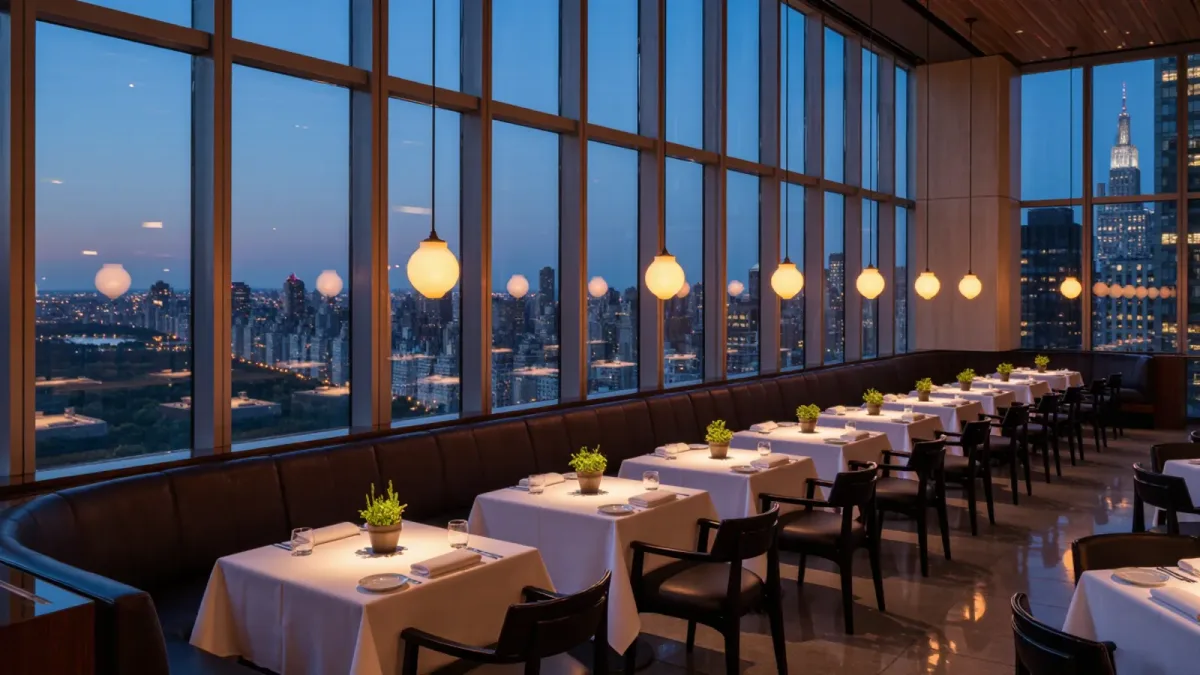
Jean-Georges opened in 1997 inside the Trump International Hotel at Columbus Circle, and the reviews redefined the city's ceiling: a glass-walled room where the menu ran French technique at Asian intensity, with vegetables and aromatics where reduction sauces used to be. The restaurant carried three Michelin stars before the guide demoted it to two in 2016, per Reuters, and has held stars since the guide's New York edition began; the kitchen still serves a “1997 menu” of the opening-era classics, per the company's own listings — ginger-marinated tenderloin among them. Nougatine, the more casual room on the same floor, runs the daytime and café trade, and the pair established the template for everything that followed.
The abc decade and the two-tier model
The model that scaled was two-tier: a luxury flagship at the top, and casual rooms below it trading on the same name and kitchen discipline. abc kitchen, opened in 2010 at the ABC Carpet & Home building in Flatiron, became the template's biggest success — organic, design-driven, priced for the neighborhood instead of the expense account — followed by abcV for the plant-based end and abc cocina for the Spanish-inflected middle. The economics are the same ladder-pricing logic every chef-owner runs, executed at group scale: the name over the door captures the whole price range, from a $20 lunch to the flagship's tasting menus, and each tier feeds the brand of the others.
The staff-meal legend and the kitchen culture
One biographical detail explains the group's kitchen culture more than any award: Vongerichten's widely reported insistence on cooking the staff meal himself in the flagship's early years — a practice the trade press documented as a recruitment argument in an industry where back-of-house eating is usually an afterthought. Whatever the frequency today, the gesture framed the brand's kitchen identity: a cook trained in France's brigade system running a New York group that markets the welfare of its kitchens alongside its menus. For an industry that staffs through reputation as much as through pay, that framing has been among the group's quietest competitive advantages.
What the map teaches
The Jean-Georges career is the widest demonstration of a New York rule: geography is the business model. The group's Manhattan rooms cluster where foot traffic is institutional — Columbus Circle's hotel and concert trade, Flatiron's design-district lunch, the Seaport's tourist corridor — and each room is sized and priced for its block. The lesson for the industry's map-watchers is structural: a chef's name scales only as fast as the rooms underneath it hold their neighborhoods, and the 60-restaurant count, per the company's own materials, is less a footprint than a portfolio of blocks, each one earned the same way the first one was.