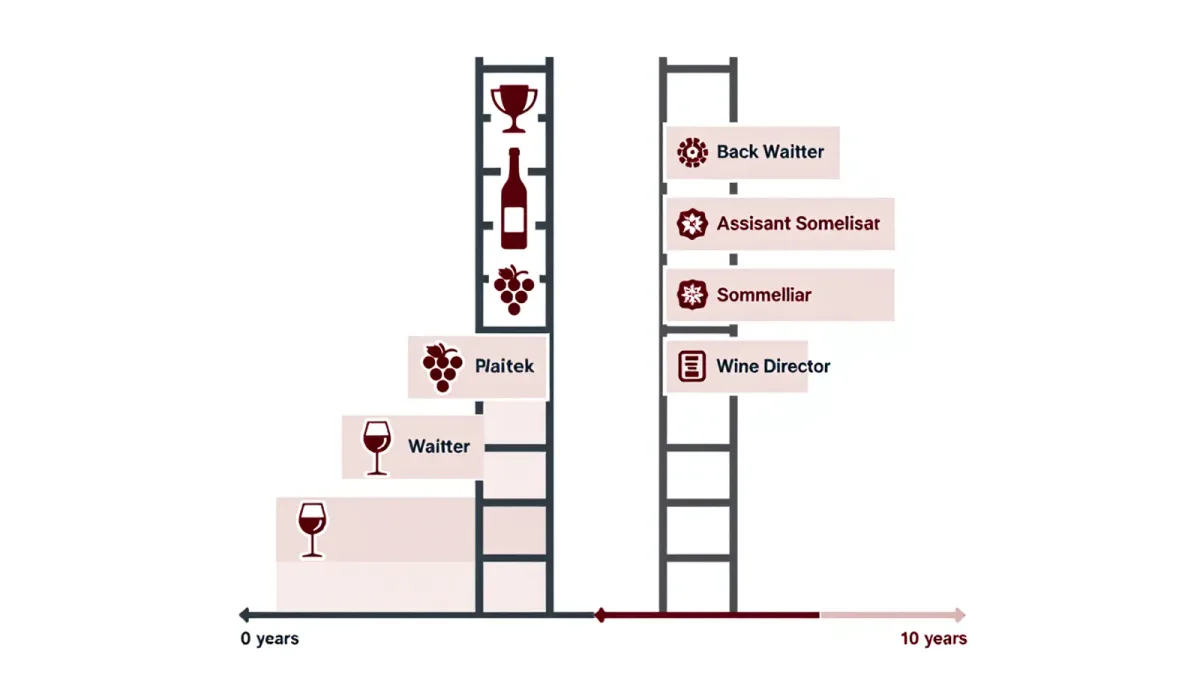
The sommelier's path in New York runs on two parallel tracks: the floor, where you learn service by pouring it, and the exams, where a series of increasingly hard tests converts tasting skill into a credential the industry recognizes. The climb from back waiter to wine director in Manhattan typically takes six to ten years, and the certification ladder runs from the introductory level to the Master Sommelier diploma — an exam fewer than 300 people have passed worldwide since 1969 — with a parallel master's track for wine educators. Here is how the New York version of that career works as of 2026: the study order, the floor jobs that matter, and the honest pay math.
A scope note: this site publishes information, not career advice. Certification bodies' requirements change, so verify the current exam structure with the organizations themselves before planning around it.
What does the certification ladder look like?
Two organizations dominate American wine credentials. The Court of Master Sommeliers runs the restaurant-industry ladder — introductory, certified, advanced, and the Master Sommelier diploma — with service and blind tasting components that test the floor skills the job uses nightly. The Wine & Spirit Education Trust runs the knowledge ladder, from its entry awards through the Level 4 diploma, and its certifications carry more weight on the buying and importing side of the trade. Most New York sommeliers stack the two: WSET for depth, Court for service. The pass rates sharpen as the ladder rises — the Court's advanced and master's exams are famously fail-heavy, and candidates commonly budget years of study for a single level.
What does the study math look like?
The middle levels of the ladder are a part-time job: candidates for the Court's certified and advanced exams typically study 12 to 24 months per level — maps, grape varieties, regions, laws, vintages — while working full service, tasting systematically against the blind-tasting grid, and drilling theory in the study groups that every serious wine city runs. New York's version of that culture is dense: trade tastings, importer portfolios, and staff tastings at the city's wine-driven restaurants give a working sommelier more glasses of reference wine in a year than most cities' candidates see in three. The honest cost: exam fees that climb into the four figures per sitting at the upper levels, plus wine, books, and travel.
Which floor jobs build the career?
The progression is consistent across Manhattan. Start as a food runner or back waiter at a wine-driven restaurant — the West Village, the Lower East Side, and the Midtown hotel tier carry the deepest cellars. The first wine job is usually assistant sommelier: inventory, deliveries, restocking the cellar, and Saturday section service with a headset of wine questions. Sommelier follows, with the buying input and the service team management; wine director — the position that owns the list, the imports, and the budget — closes the loop at the six-to-ten-year mark. New York's advantage is density: the city holds more wine-list-driven dining rooms per square mile than anywhere in the country, so a capable assistant sommelier can change rooms, and grow the cellar exposure, without leaving the island.
What does the job actually pay?
The pay is service economics, not salary economics. An assistant sommelier in New York earns a floor wage plus tips comparable to a captain; a sommelier at a serious list earns more, with the uplift coming from the wine-specific tips and, at some rooms, commission on bottle sales. The real money sits at wine director and beverage director level — salaried positions at restaurant groups, hotel properties, and the retail-and-import side that recruits from restaurant floors. The trade that candidates accept: the study hours are unpaid, the exams are expensive, and the payoff arrives late, in the director roles and in the import and distribution careers the credential unlocks.
Where New York trains its wine staff
Formal wine education runs on two channels in the city: the certification bodies' own courses and study groups, and the growing beverage-management programs inside hospitality schools, including the university hospitality programs that now teach wine service, list building, and purchasing as degree coursework. The third channel is the restaurants themselves — the city's wine-driven rooms run some of the trade's best informal schools, with weekly staff tastings, cellar sessions, and managers who treat the map work as service prep. A candidate combining all three — a study group for the grid, courses for the credential, and a wine-heavy floor for the daily reps — moves through the ladder's early levels faster than any one channel allows.
Is the credential required?
No — and New York's most influential wine directors include lifers who never sat the master's exam. What the credential buys is hiring leverage and speed: a certified or advanced pin on the lapel moves a candidate up the interview stack at the city's wine-driven rooms, and the study structure substitutes for the mentorship some kitchens lack. The floor skill, though, is the gate. The exam tests what a good New York service shift demands — taste, recall, and the diplomacy to steer a $200 bottle decision without arrogance — and the restaurants that hire sommeliers can tell, within one table, who studied for the test and who learned the room.