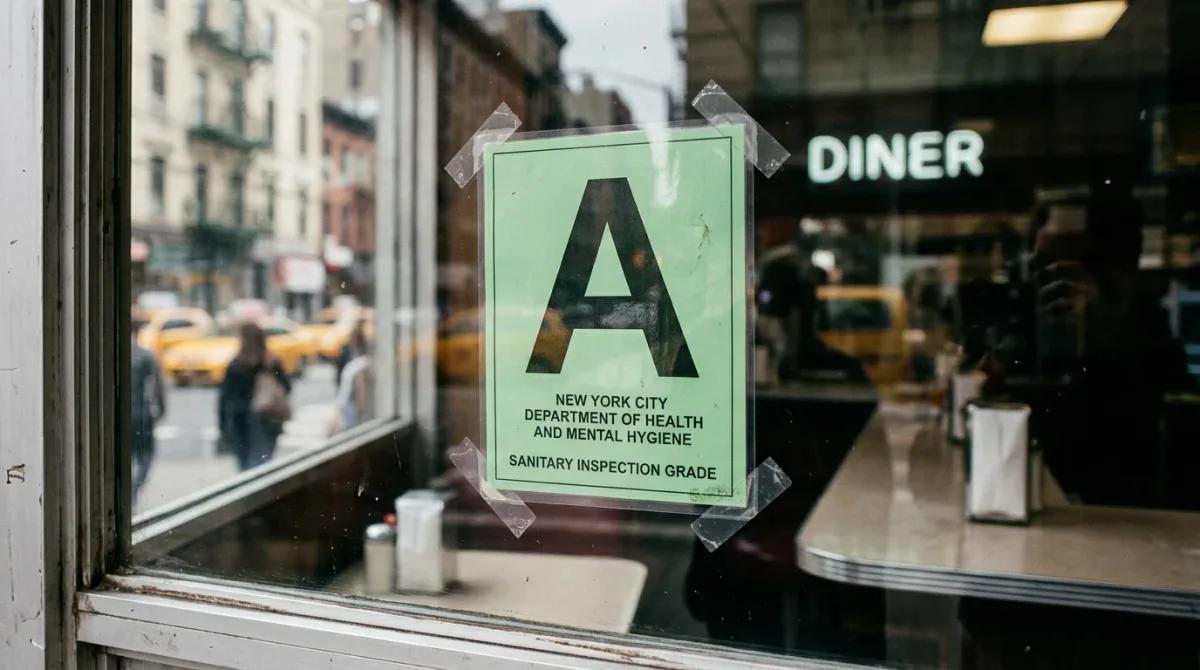
That laminated A, B, or C by the door of a New York restaurant is a scorecard, not an opinion. The city's Health Department assigns it after a sanitary inspection, using a points system where zero to 13 points earns an A, 14 to 27 points earns a B, and 28 or more earns a C — fewer points is better, and the grade must be posted where passersby can see it.
The program is fifteen years old this cycle. It launched in July 2010 and now covers roughly 29,000 restaurants citywide, according to the Health Department's own anniversary release marking the milestone in 2025. "Every restaurant can keep customers safe and achieve an A grade by consistently observing essential food safety practices," Deputy Commissioner for Environmental Health Corinne Schiff said in that release — proper food temperatures, hand washing, and pest control, in the department's telling, are what separate an A kitchen from a C one.
What actually costs a restaurant points
The inspections themselves aren't optional or complaint-only. The Health Department inspects every food service establishment in the city to make sure it meets Health Code requirements and to help prevent foodborne illness, per the department's inspection-cycle guidance — that includes the routine visits that generate a restaurant's first grade, not just responses to a diner's complaint. The same guidance notes the department can also order a restaurant closed outright for serious violations, or for operating without the proper permits, independent of whatever letter grade is on the door.
Every inspection generates a tally, and violations aren't weighted equally. A general violation — say, improperly sanitized cooking equipment — adds at least 2 points, per the department's grading FAQ. A critical violation, like serving a salad that wasn't properly washed, carries a minimum of 5 points. The steepest category is a public health hazard — a temperature-control failure is the department's example — which starts at a minimum of 7 points and, if it isn't resolved on the spot, can trigger an immediate closure rather than just a grade hit.
Add it up and the thresholds do the rest of the work: a kitchen can absorb a couple of general violations and still land in A territory, but one uncorrected public health hazard is close to half the points needed to fall into C range by itself.
Why some restaurants post two cards at once
A restaurant doesn't always walk away from its first inspection with a final grade. If that initial visit scores a B or C, the Health Department schedules an unannounced re-inspection, typically within a month, according to the grading FAQ. Until a grade is finalized, the operator can display a grade pending card alongside — or instead of — the numeric grade card, and either one is allowed to stay up until the matter is resolved at a hearing before the Office of Administrative Trials and Hearings Health Tribunal, per the department's inspection-cycle guidance. That's the appeals step: a restaurant can contest points before the grade becomes official, which is why a diner might occasionally see a pending notice rather than a clean letter on the door.
How often the inspector comes back
The inspection clock resets based on performance, not the calendar alone. A restaurant that scores in the A range (0–13 points) on its inspection is typically inspected again in roughly 11 to 13 months, per the department's cycle overview. Score higher and the timeline compresses: establishments landing in the 14-point-plus range are subject to reinspection within roughly 3 to 7 months of that cycle, with the department noting that a restaurant's highest recorded score in a period shapes how soon it sees an inspector next — landing anywhere from about 3 to 7 months out depending on the score. The logic is straightforward: a kitchen that's already struggling gets checked on sooner.
What the grade doesn't tell you
The letter grade is a snapshot of one inspection day, not a running average, and it says nothing about the food itself — cooking, seasoning, and value aren't part of the Health Code. It's also not the only record available. The department publishes full inspection results, including the underlying violations behind any grade, through its ABC Eats resource, and diners who want the granular version — not just the letter on the door — can look up any address there before they book a table.
None of that changes what the card by the host stand means in practice: it's a compliance score with real teeth, backed by a hearing process a restaurant can actually contest, on a re-inspection clock the city resets restaurant by restaurant.
FAQ
- What does a Grade Pending card mean? It means the restaurant scored a B or C on an inspection and is awaiting a hearing at the OATH Health Tribunal, or a re-inspection, before a final grade is posted, per the Health Department's grading FAQ.
- How many points is an automatic C? 28 points or more, per the department's official scoring thresholds.
- Can one violation trigger a closure, not just a grade? Yes — a public health hazard violation, which starts at a minimum of 7 points, can lead to immediate closure if it isn't corrected during the inspection, according to the department's FAQ.
- How soon does a failing restaurant get reinspected? The department typically returns for an unannounced re-inspection within about a month of an initial B or C score, per its grading FAQ.
For a related restaurant news perspective, read How a Manhattan restaurant actually gets permission to put tables on the sidewalk.